

to speech-read
- verb
- /spiːtʃ riːd/
- UK
- She relies on speech-reading to understand what her friends are saying during conversations.
Examples
-
Children who are deaf and included in mainstream classrooms generally rely more on spoken language and supports that assist them with hearing or understanding spoken language, such as speech reading, hearing aids, and interpreters (Stinson, 2008).
Academic text (2014) -
It is important to note that individuals who have received a cochlear implant may or may not communicate primarily through listening and speaking. Lip reading is also known as speech reading.
Academic text (2014) -
Those who use spoken language will have a similar problem speech-reading in a group and following a rapid conversation.
Academic text (1997) -
As the loss of vision progresses, speech-reading becomes more difficult.
Academic text (1997) -
The person with Type II may well use sign language, first visually, to augment speech-reading and hearing, and later tactilely, when the signs can no longer be received visually.
Academic text (1997) -
These children probably use some kind of sign language system; some parents learn it to ease communication at home, and some do not, preferring to rely on speech reading (lip reading), note writing, and gestures to communicate.
Academic text (1997) -
I worked tirelessly with speech therapists on speech reading (lip reading but more involved) and learning voice volume control in my new world of not hearing oneself speak.
Blog text (9) -
In noisy environments, he finds speech-reading essential for following along without misunderstanding.
-
Many students in the class practice speech-reading to enhance their communication skills during discussions.
Synonyms

 11
5.7
11
5.7

To understand what someone says by watching their lips
 4
7.2
4
7.2
Understand what someone says by looking at their mouth
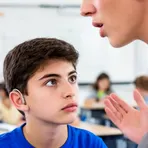
To understand what someone says by watching their lips
How Accurate

Surface Forms
Morphology
Etymology
Speech-read combines speech ('spoken words') and read ('to understand by looking'), so it is like 'reading' what someone says with your eyes. It means to understand spoken words by watching a person's lips and face instead of hearing them.