
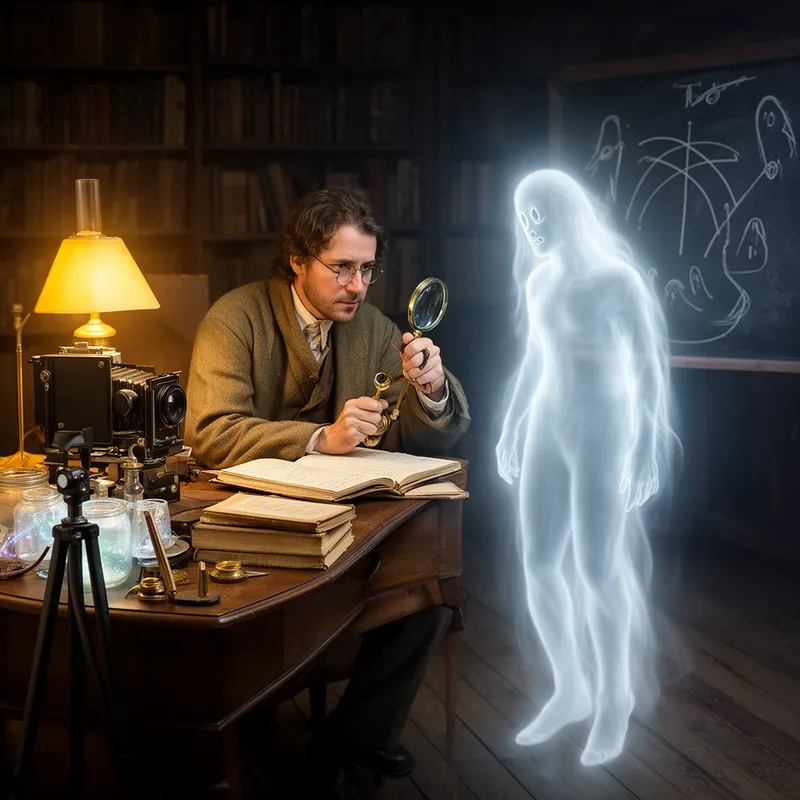
spectrology
- noun
- /spɛkˈtrɑlədʒi/
- Archaic
- Interest in spectrology declined as scientific understanding of the world increased.
Examples
-
I find spectrology fascinating.
-
Books on spectrology often combined scientific language with supernatural claims.
-
In the nineteenth century, spectrology was sometimes considered a serious academic pursuit.
-
The field of spectrology fascinated many in the 19th century.
-
The professor invited students to explore the field of spectrology and its historical significance.
-
In ancient cultures, spectrology was often practiced to understand the presence of spirits.
-
Many researchers have dismissed spectrology as a pseudoscience due to the lack of empirical evidence.
Synonyms

 3
9.9
3
9.9

The study of claimed mental powers like telepathy or moving objects with the mind
How Scientific

Surface Forms
Morphology
spectrology = spectro (opaque) = spectro + logy
Although the form is visibly a learned coinage, the ghost-related sense is not a predictable modern meaning of spectro- and would not be reliably inferred by learners.
Etymology
Spectrology also traces back to spectrum, which once meant 'an appearance' and led to the English word specter meaning 'ghost'. A helpful way to remember this is to think of a specter as an 'appearance', so spectrology was once used for the study of ghosts and apparitions.