
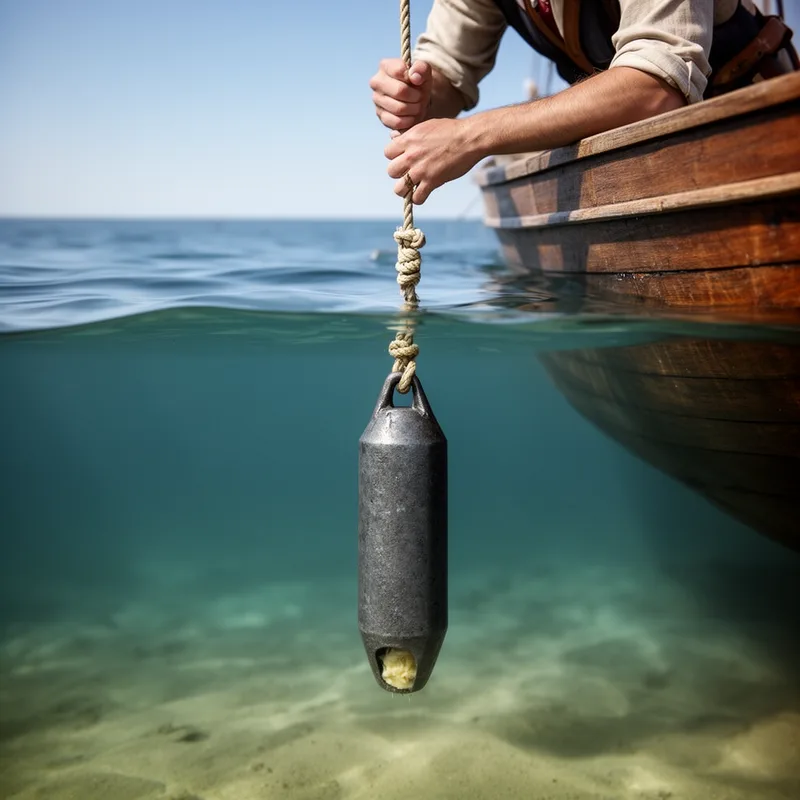
sounding lead


 1
9.3
1
9.3
- noun
- /ˈsaʊndɪŋ lɛd/
- Archaic
- Before approaching the harbor, they used a sounding lead to avoid running aground.
Examples
-
The fisherman dropped the sounding lead into the water.
-
The sailor dropped the sounding lead overboard to check how deep the river was.
-
A traditional sounding lead often has tallow in its hollow base to pick up samples from the seabed.
-
Using a sounding lead helps determine the depth of the lake.
-
The fisherman used a sounding lead to check how deep the water was.
-
She lowered the sounding lead into the lake to find the perfect fishing spot.
-
Using a sounding lead, they measured the depth of the river before navigating their boat.
Synonyms
 1
8.1
1
8.1
A rope with a heavy lead weight that sailors lower to measure water depth from a boat

A rope with a weight that you drop to measure how deep the water is

A tool that measures how deep water is, for example in the sea or a lake

A device that uses sound waves to measure how deep water or things under it are
Surface Forms
Morphology
The compound is directly compositional: 'sounding' denotes measuring water depth and 'lead' denotes a heavy metal (used as a weight), so a 'sounding lead' is transparently a metal weight used for sounding. Although maritime and somewhat technical, the meaning follows straightforward English compounding and would be inferable to a B1 learner who knows both constituents.
Etymology
Sounding lead comes from a simple sea tool: sailors dropped a heavy metal lead on a rope so the sounding would 'measure' the water's depth. The weight could even pick up a bit of mud from the bottom, so the name now means a device used to check how deep the water is.