
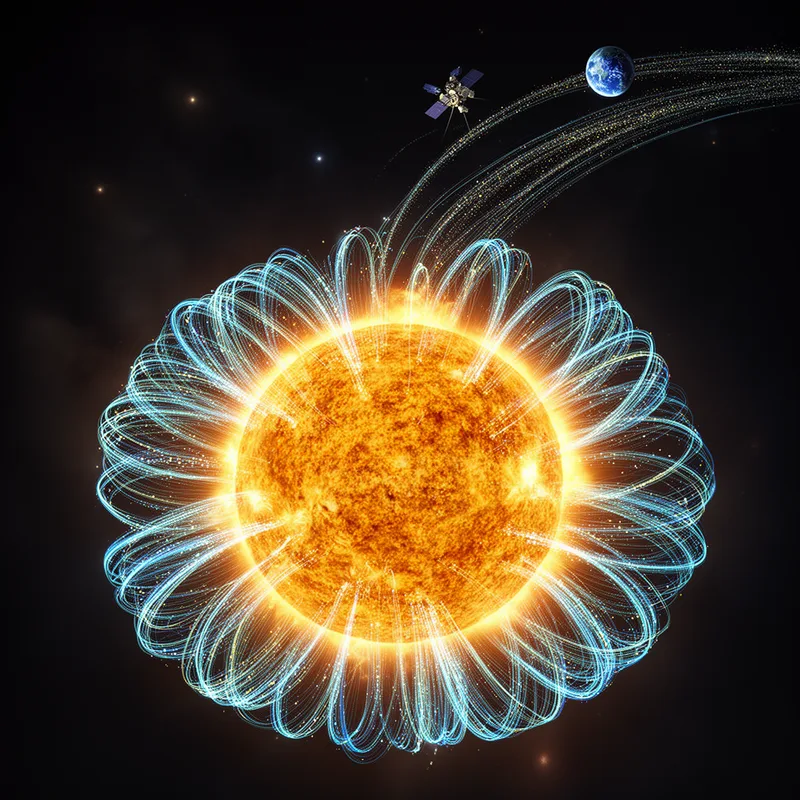
solar magnetic field


 1
5.7
1
5.7
- noun
- /ˈsoʊlər mæɡˈnɛtɪk fiːld/
- Specialized
- Research shows that variations in the solar magnetic field can lead to auroras on Earth.
Examples
-
About 30 times more powerful than the average field around the sun (the solar magnetic field is about 50 Gauss, about the same as a refrigerator magnet).
Blog text (29) -
Since 2003, the solar magnetic field has been going down.
Blog text (23) -
The "30% drop in solar magnetic field" I don't recall (I may have dozed off at that point).
Blog text (28) -
In turn, this depends on the activity of the sun, i.e., the extent of the solar magnetic field exerted by the sun on the planetary system.
Blog text (23) -
Measurements of the solar magnetic field were first made by the great American astronomer and telescope builder George Ellery Hale.
Academic text (1991) -
Two cycle-dependent phenomena were presented: variable solar ultraviolet radiation and variable solar magnetic fields that are both solar-cycle dependent.
Academic text (2010) -
We covered this story about solar magnetic field strength and sunspot contrast months ago on WUWT, and for a couple of years now I have been pointing out that the Ap Interplanetary magnetic index took a dive and has stayed at low levels.
Blog text (29) -
We now realize that the structure seen in the solar corona, including polar plumes and equatorial streamers, results from matter being constrained by the solar magnetic field.
Academic text (1991) -
The solar magnetic field influences space weather and affects communications on Earth.
-
Scientists monitor the solar magnetic field to understand its impact on satellite operations.
Surface Forms
Morphology
The phrase is transparently compositional: 'solar' (of the sun) modifies 'magnetic' (relating to magnetism) and together they specify a type of 'field' (a region of force), yielding 'the magnetic field produced by the sun.' This follows standard modifier+noun composition and cross-linguistic analogy, so a B1 learner who knows the constituent words can reliably infer the meaning.
Etymology
Solar magnetic field comes from imagining the solar part as the Sun and the magnetic field as a huge, invisible magnet with lines that reach out into space. That's why it means 'the magnetic field produced by and surrounding the sun' and why it can change space weather and affect satellites.