

snowshoe rabbit


 1
3.9
1
3.9
- noun
- /ˈsnoʊˌʃuː ˈræbɪt/
- US
- "I forgot to tell you that snowshoe rabbits turn white in the winter," Mama said.
- saw a snowshoe rabbit
Examples
-
On a cold winter day, we spotted a snowshoe rabbit hopping through the snow, its white fur blending perfectly with the landscape.
-
One night, while driving home, I saw a snowshoe rabbit.
Fiction book (1997) -
Two little snowshoe rabbits sat on an old log.
Fiction book (2000) -
The snowshoe rabbit is known for its large feet, which help it navigate through the deep snow of its northern habitat.
-
During our hike, we were lucky to see a snowshoe rabbit swiftly darting among the trees, its winter coat making it nearly invisible.
Synonyms
 1
6.5
1
6.5
A large North American hare with big feet that turns white in winter and brown in summer
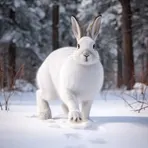
A large North American hare with big furry feet that turns white in winter

A large North American hare with big feet that turns white in winter
Surface Forms
Morphology
snowshoe + rabbit
The meaning (‘a rabbit with large feet adapted for snow’) is transparently derived from combining 'snowshoe' (a device/attribute preventing sinking in snow) with 'rabbit' (the animal), so a learner who knows both words can infer it denotes a rabbit with snow-adapted/large feet. This is a regular noun–noun compound pattern found cross-linguistically, so it should be immediately comprehensible to a B1 learner.
Etymology
Snowshoe rabbit The name snowshoe rabbit comes from the animal's very large back feet that look like snowshoes and help the rabbit move across deep snow. In winter its fur turns white to 'blend in', so the name describes a rabbit made for snowy places.