

snow leopard
 8
4.8
8
4.8

- noun
- /snoʊ ˈlɛpərd/
- One of the smallest of their big-cat genus (lions, tigers, snow leopards, and jaguars are also members), leopards once lived in eastern and southern Asia and all of Africa, from Siberia to the Cape of Good Hope.
- a wild snow leopard
- see a snow leopard
- snow leopards here
Loading YouTube…
Watch on YouTubeThey're they're sleeping out in the extreme heat and they are there to protect the livestock from snow leopards, wolves, and even bears just to scare the bears off.
- They're they're sleeping out in the extreme heat and they are there to protect the livestock from snow leopards, wolves, and even bears just to scare the bears off.
Examples
-
Silent and sleek, a snow leopard climbs to a rocky ledge high in the mountains of Mongolia.
-
HIMALAYAN SNOW LEOPARD.
-
You look like a snow leopard!
-
To our surprise, we see a couple of snow leopards.
Academic text (2000) -
He said he wants to photograph snow leopards.
-
For your wildlife, the big cats are always enchanting, and I love snow leopards.
Blog text (18) -
There's a snow leopard.
-
They're they're sleeping out in the extreme heat and they are there to protect the livestock from snow leopards, wolves, and even bears just to scare the bears off.
-
I also knew that the snow leopards were poached for furs, amulets, and folk medicines, their carcasses smuggled across the border.
Fiction book (1991) -
Weighing just under a hundred pounds, an adult snow leopard could easily bring down a person.
Synonyms
 7
9.9
7
9.9
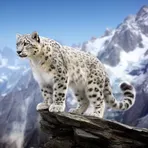
A large wild cat with thick pale fur that lives in high mountains
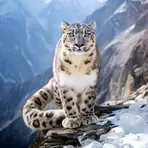
A large wild cat with thick pale fur that lives in high Asian mountains
How Big

Surface Forms
Morphology
The meaning is directly and transparently built from 'snow' (associated with white, cold environments) + 'leopard' (a big spotted cat): it denotes a leopard associated with snowy habitats/appearance. This is a common attributive noun-noun compound cross-linguistically, so a B1 learner who knows both words would readily infer the referent.
Etymology
Snow leopard gets its name from its pale, spotted fur and from living on snow-covered mountain peaks. So it is literally a leopard of the snow, and the name describes this large 'wild cat' found in high 'mountains'.