

sluice gate


 1
6.5
1
6.5
- noun
- /slus ɡeɪt/
- Specialized
- A sluice gate, half hidden behind the roof of the mill, controls the water to power the waterwheel.
- open the sluice gate
Loading YouTube…
Watch on YouTubeHe spent his time building buildings for the new Danube canal sluice gates.
- He spent his time building buildings for the new Danube canal sluice gates.
Examples
-
They were opening a sluice gate to fill a newly excavated pool.
Fiction book (1992) -
Three years later, dam operators at Cahora Bassa opened all eight sluice gates and the emergency spill gates in rapid succession to alleviate pressure on the dam walls.
Academic text (2005) -
We need to find the sluice gate.
-
Where is the sluice gate?
-
"All right, boys, open the sluice gate."
Fiction book (1991) -
That must be the mechanism that controls the sluice gate.
-
The sluice gates of the reservoir are still sites of worship today.
Academic text (2009) -
Okay, if this is an aqueduct, we just need to somehow open the sluice gate.
-
Each big reservoir we visit has sluice gates, offshore stone towers used to control the flow of water through dams and into fields below.
Academic text (2009) -
The workers opened the sluice gate to allow more water to flow into the irrigation system.
Synonyms
 5
4.0
5
4.0
A metal door that controls water flowing through a dam or channel
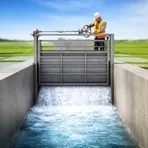
A gate that controls the flow of water in a channel
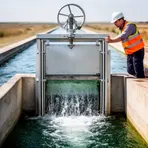
A gate that controls water flow in a canal

A gate or valve that controls water flow in dams and canals

A movable barrier at the start of a canal that controls water flow

A gate that opens and closes to let boats pass and control water in a canal
How Effective

Surface Forms
Morphology
Given knowledge of 'sluice' (a passage controlling water) and 'gate' (a barrier), the compound 'sluice gate' is directly interpretable as the gate that controls water flow. The construction is fully compositional (noun+noun technical compound) despite being domain-specific, so a B1 learner who knows the constituents will understand the meaning.
Etymology
The noun sluice gate comes from a simple image of farmers and mill workers using a sliding wooden sluice and a gate to hold back water and then open it to let the water flow where needed. That's why today it means 'a gate you open or close to control the flow of water'.