

slip carriage
- noun
- Archaic
- In the early 20th century, the express train often included a slip carriage for passengers bound for smaller stations.
Examples
-
The guard prepared to release the slip carriage as the train approached the junction.
-
The train's last slip carriage detached smoothly.
-
Few people today have seen a slip carriage in operation, as the practice has long since faded.
-
They added a slip carriage to the end of the train.
-
The train's slip carriage allowed passengers to disembark at the station without halting the entire service.
-
When the train reached the small station, the conductor released the slip carriage to let passengers get off.
-
Historically, a slip carriage was essential for express trains to stop at minor stations efficiently.
Synonyms
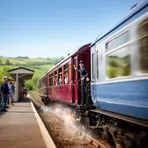
A carriage at the end of a train that can detach while the train moves to stop at a station
Surface Forms
Morphology
The compound is built transparently from 'slip' (to move/slide) and 'carriage' (a rail vehicle), so a learner will infer it denotes a type of carriage that 'slips' or moves relative to the train. However, the precise technical sense — that it can be detached while the train is still moving to stop at a station — is a specialized procedural detail not fully predictable from the constituents alone, making the expression only partially transparent to a B1 learner.
Etymology
The noun slip carriage comes from an old railway practice: the last carriage could be slipped off a moving train and 'detached' so it slowed and stopped at a small station while the rest of the train kept going. So the name describes a carriage that literally 'slips' away from the train while it is moving.

