
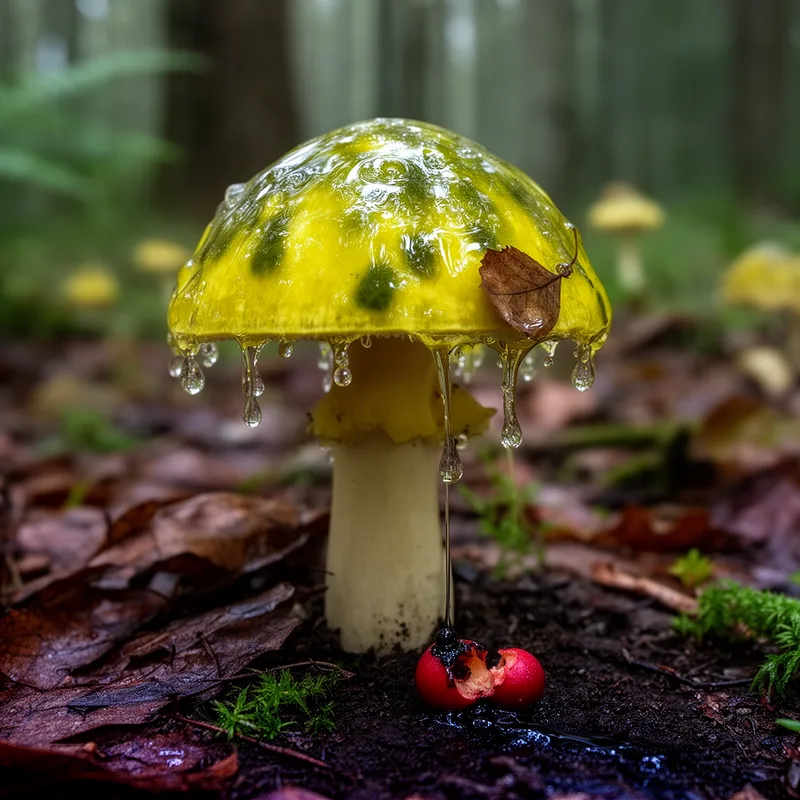
slime mushroom
- noun
- /slaɪm ˈmʌʃrum/
- Under the shady trees grew a particularly large slime mushroom with a shiny, sticky cap.
Examples
-
The forest floor was dotted with slime mushrooms after the rain.
-
The slime mushroom is often found in damp forest areas.
-
Some species of slime mushroom are highly poisonous and should not be eaten.
-
Have you ever seen a slime mushroom in the wild?
-
The forest floor was dotted with slime mushrooms after the rain.
-
Under the shady trees grew a particularly large slime mushroom with a shiny, sticky cap.
-
Some species of slime mushrooms are highly poisonous and should not be eaten.
Synonyms

 236
1.0
236
1.0

A soft fungus with a cap and stalk that grows on soil and is sometimes edible
 1
9.8
1
9.8
The scientific name for a group of mushrooms many of which are poisonous
Surface Forms
Morphology
The compound 'slime mushroom' simply combines 'slime' (a viscous substance) with 'mushroom' to indicate a mushroom that is slimy or has a slimy cap, so a B1 learner who knows both words can infer the meaning. This attributive noun-noun composition describing a physical property is cross-linguistically common and therefore immediately transparent.
Etymology
Slime mushroom comes from the shiny, sticky cap many mushrooms show after rain, because of the slime on top. So the name now refers to certain mushrooms that are known for a 'slimy' cap.