
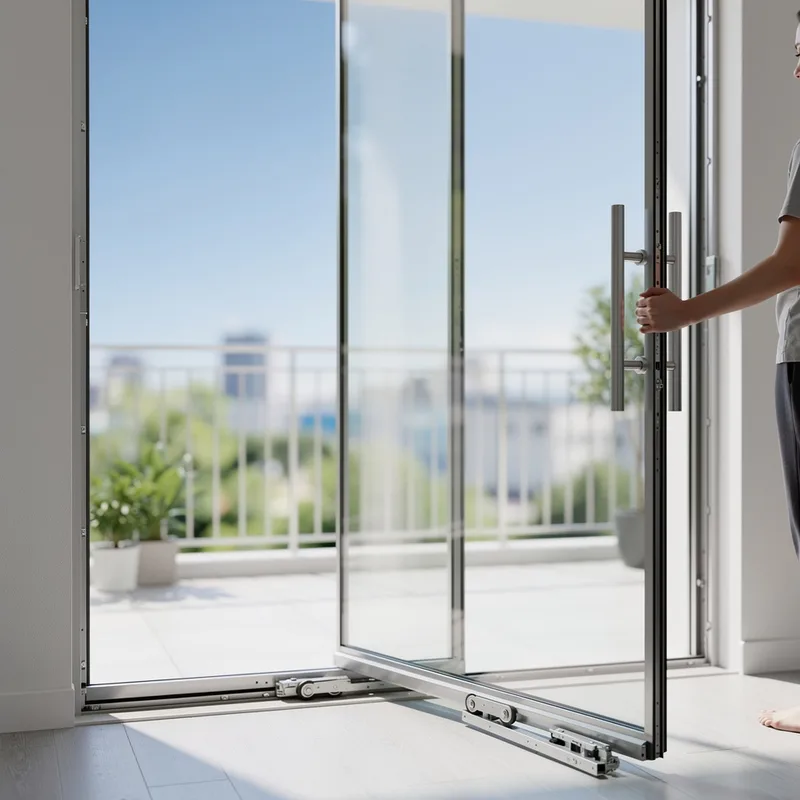
sliding door
 5
2.1
5
2.1

- noun
- /ˈslaɪdɪŋ dɔr/
- After a moment, he walks across the room to the sliding doors that lead to the balcony outside.
- glass sliding doors
- automatic sliding doors
- sliding doors on a balcony
Loading YouTube…
Watch on YouTubeHe's heading towards the sliding door, trying to leave.
- He's heading towards the sliding door, trying to leave.
- So you've got two stories of cells, bottom tier, upper tier, metal grid stirs going to the upper tier, and a sliding door at the front.
- He opens like the sliding door to the van unbuckles me like rips me out of the car seat, pulls me on to this.
Examples
-
Mo and Shades step through the sliding doors into a large hall.
Fiction book (1990) -
The stone-and-wood structure was predominantly glass: large picture windows and sliding doors leading out to the wraparound veranda.
Fiction book (1996) -
We open the sliding doors so we can hear some of the the sounds from nature.
-
Then when they open the sliding doors, you soon learn not to slam them as well.
-
The kitchen had its own wall of glass and sliding doors out to the terrace.
Fiction book (2001) -
I turned to face the glass sliding doors leading to a narrow balcony.
Fiction book (2000) -
I don't turn around when I hear the sliding door open and close.
Fiction book (1991) -
A woman stands by the sliding door leading to the boat's salon.
Fiction book (2002) -
It has dual sliding doors like those vans, and it can carry eight people.
-
The kitchen had its own wall of glass and sliding doors out to the terrace.
Synonyms
 ∞
1.0
∞
1.0
A thing in a wall, building or vehicle that opens so people can go in and out
Antonyms
How Space-Saving
5
2.1
 1
2.8
1
2.8
Surface Forms
Morphology
The meaning 'a missed opportunity' is not compositionally derived from 'sliding' (moving smoothly) + 'door' (an entry barrier); the literal image of a moving door does not predict the abstract idea of a life-changing missed chance. This usage is largely idiomatic and tied to a cultural/film reference (e.g. the movie Sliding Doors), so a B1 learner who knows the individual words but has not seen the expression before would not reliably infer the intended meaning.
Etymology
The noun sliding door describes a sliding door that moves sideways on a track instead of swinging. That clear picture explains why it means 'a door that saves space and opens quietly'.