

to sleep in
 5
6.3
5
6.3

- phrasal verb
- /slip ɪn/
- Archaic
- We sleep in my significant other's childhood bedroom.
Examples
-
Uh, could you give me the permission to sleep in my cousin's office until I find for myself a room?
-
The poor couple kindly replied, "You two may sleep in our bed tonight; we will take the living floor for the night."
Blog text (30) -
It's not a hotel, Please do not sleep in your office.
-
Tonight, they will not be welcome to sleep in the house.
-
And my office is all ready for them to sleep in.
-
You can sleep in the place where I work.
Fiction book (1992) -
Both of them sleep in my room at night.
Blog text (17) -
We’ll have to sleep in the hills tonight.
Fiction book (1993) -
After the three men talked it over, Mr. Bondurant announced that henceforth he would sleep in our barn, and the others would relieve him during the day.
Fiction book (1997) -
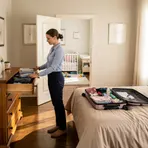
As a full-time nanny, she was required to sleep in the family's home every night.
Synonyms
 194
3.7
194
3.7
To stay and sleep where you work, usually in your employer's house
Antonyms

Surface Forms
Morphology
The constituents 'sleep' (rest) and 'in' (indicating location) give a partial clue — the phrase suggests sleeping at/inside a place — but the specific occupational sense of residing in an employer's house is a specialized, lexicalized use not directly predictable. Many learners will instead interpret 'sleep in' as 'stay in bed late', so knowing the parts is insufficient to guarantee the intended meaning without exposure.
Etymology
Sleep in used for a worker comes from the literal idea of sleeping in the employer's house so you are there to work early, so it means 'to live in the house where one works'.