
slave state
 3
7.9
3
7.9

- noun
- /sleɪv steɪt/
- NSFW
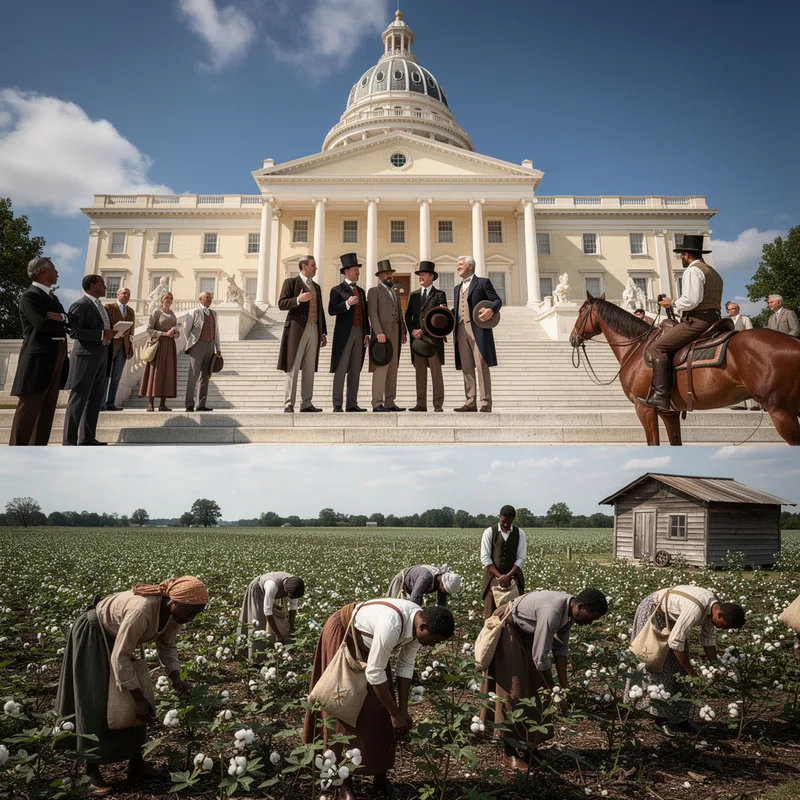
- Before the Civil War, a slave state like Virginia had different laws regarding slavery compared to the Northern states.
- slave state—Missouri
- slave states of the Union
- new slave states
Loading YouTube…
Watch on YouTubeLincoln is saying we can't end slavery in the existing slave states because slaves there are property under law.
- Lincoln is saying we can't end slavery in the existing slave states because slaves there are property under law.
- His point was if I had been born in a slave state and grown up owning slaves, I would have so much trouble seeing what is clear to me from the outside.
Examples
-
And, though Maryland was a slave state, its citizenry did not gather at White's Ford to greet the Army of Northern Virginia.
Fiction book (1992) -
Although Maryland never left the union, Maryland was a slave state, and southern views of race relations shaped the state's politics throughout the last third of the nineteenth century.
Academic text (2000) -
Next week, we'll talk about the slave states that refused to separate from the Union and the role it played in the war.
-
Meetings were held throughout the South to support the settlers from the slave states.
Academic text (2009) -
Lincoln is saying we can't end slavery in the existing slave states because slaves there are property under law.
-
That would leave slavery constitutionally protected only in the slave states that had remained loyal to the Union.
Academic text (1999) -
Like Calhoun, Benton was an important senator representing a slave state—Missouri, in Benton’s case.
Academic text (2016) -
Born and raised in Maryland, a border state, a slave state that did not secede from the Union, John Wilkes Booth is also a Southern zealot, whose hatred of Abraham Lincoln is nothing less than fanatical.
-
In the years leading up to the Civil War, many politicians debated over the admission of new territories as free or slave states.
-
The establishment of a slave state often led to tensions over the spread of slavery into new territories.
Antonyms

- Archaic

 1
6.9
1
6.9
A state where laws did not allow people to own slaves before the American Civil War
Surface Forms
Morphology
The meaning 'a state in which slavery exists or was legal' is directly and compositionally derivable from 'slave' (person forced to work) + 'state' (political region). This noun+noun combination follows a regular and cross-linguistically common compounding pattern, so a B1 learner who knows both words should be able to infer the MWE's meaning.
Etymology
Slave state comes from 19th-century United States talk and literally names a state where people could legally own slaves. So, it means 'a state where slavery was legal'.