
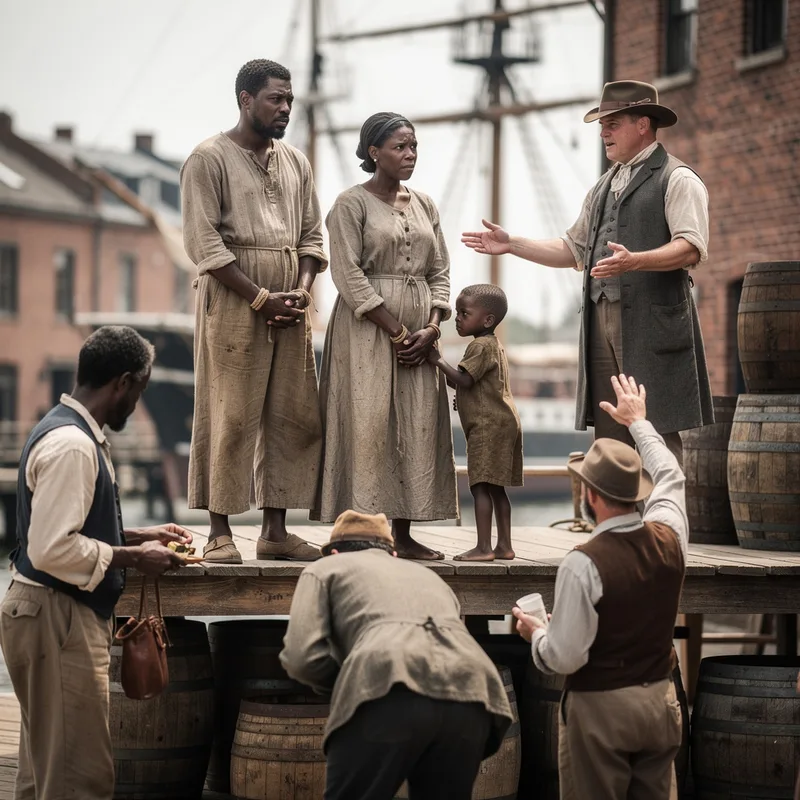
slave market
 3
8.0
3
8.0

- noun
- /sleɪv ˈmɑrkɪt/
- NSFW
- I saw a barge once, Mr. Yeaman, filled with colored men in chains heading down the Mississippi to the New Orleans slave markets.
Examples
-
The Greek captain sold him for me in the slave market of Djidda for forty-eight dollars.
Academic text (2008) -
"How much did you pay for Taby at the slave market?" He stiffened.
Fiction book (1994) -
Have you never seen a slave market, Mr. Frank?
-
The one where you go to the slave market.
-
The Archives is no longer a slave market.
Blog text (15) -
Now, I have to go to Charleston to set up the slave market.
-
His father was sold at the slave market in Ouidah, and L'Ouverture, born in Santa Domingo around 1743, lived as a slave for forty years.
Academic text (2001) -
Because of the massive scope of the trade in New Orleans, the city found itself among a select group of "cities with a large slave market that had a significant infrastructure dedicated to the buying and selling of humans," such as Richmond, in contrast to most other Southern towns and cities where "the trade did not have a permanent physical location." (418)
Academic text (2018) -
The wave swept on through the village, past the shops and businesses, the slave markets, the workhouses, the compounds and soldiers' quarters, the shabby homes of the Dwarves and the well-kept houses of the Federation officials, down the main thoroughfare, and out again.
Fiction book (1991) -
During the 19th century, the slave market was a grim place where people were sold as property.
Surface Forms
Morphology
The meaning is directly compositional: 'slave' (a person owned and forced to work) + 'market' (a place where goods are bought and sold) straightforwardly yields a place where enslaved people are bought and sold. This noun–noun compound follows a common and cross-linguistically regular pattern, so an average B1 learner who knows both constituents would be able to infer the MWE's meaning.
Etymology
Slave market comes from the very plain idea of a market where slaves were shown and sold like goods; buyers would choose and pay for people. That's why the phrase means 'a place where enslaved people were bought and sold'.