

to siphon water


 1
5.2
1
5.2
- phrasal verb
- /ˈsaɪfən ˈwɔːtər/
- The workers had to siphon water from the tank into the truck for transport.
Examples
-
He used a hose to siphon water from the pool to the garden.
-
Think somebody's been siphoning the water from the creek.
-
The momentum of the ejected water caused it to leave the boiler with a partial vacuum; this siphoned water into the boiler, and the cycle was repeated.
Academic text (2009) -
El Dorado built new wells and elected to install a prefabricated pumping system to siphon water from a pair of two-million-gallon ground storage tanks and deliver it to the distribution system.
Academic text (2003) -
They decided to siphon water from the lake using a pump.
Synonyms
 198
1.0
198
1.0
To let liquid flow away from something
 43
6.0
43
6.0
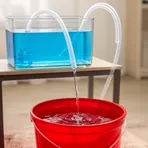
To move liquid from one container to another using a tube and gravity
 32
1.1
32
1.1
To take liquid from a container or tree
 7
1.6
7
1.6
Move water from one place to another using a machine
 2
6.6
2
6.6
To move liquid or money from one place to another slowly and often secretly
Antonyms

How Much

Surface Forms
Morphology
The meaning is directly derivable from the constituents: knowing 'siphon' (a tube or the action of moving liquid by a tube) and 'water' leads to the interpretation 'to move or draw water using a siphon'. The action is literal and mechanistic (not idiomatic), and similar constructions exist across languages, so a B1 learner who knows both words should understand it.
Etymology
Siphon water comes from the image of a long tube called a siphon. You start the flow and water runs from a higher place to a lower place by itself, so the phrase means 'to move water from one place to another using a tube'.