
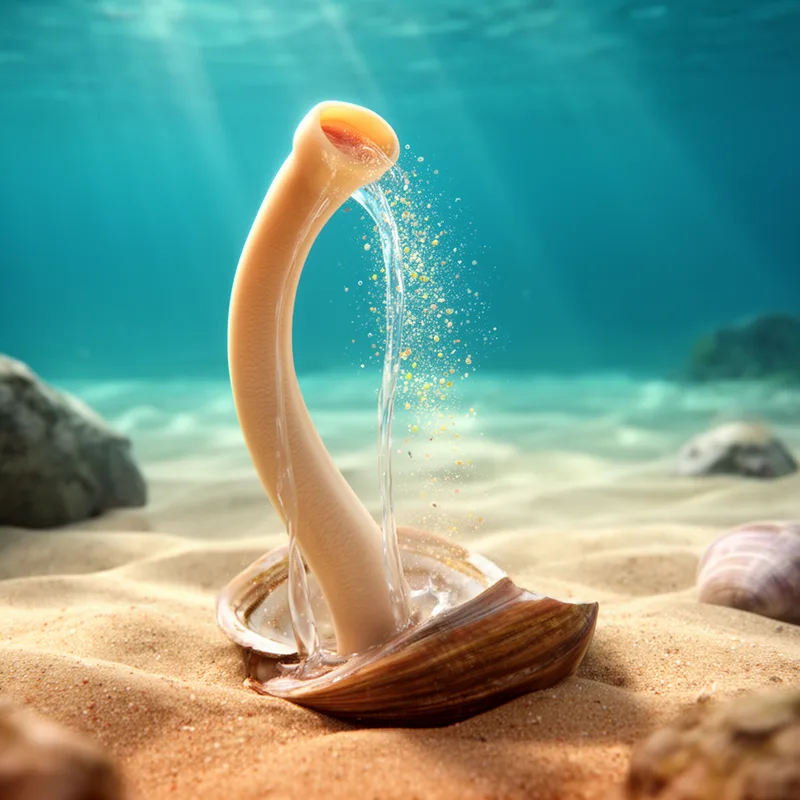
siphon
 2
7.2
2
7.2

- noun
- /ˈsaɪfən/
- Specialized
- "We have no proof and little evidence that they evolved from siphons," Dani admitted.
- clams' siphons
- siphon worms
Examples
-
Innocently I said, "Why, I thought the evolution and radiation of the siphon worms was of far greater importance."
Fiction book (2001) -
On approaching the prey, the snail extends both the siphon and the tentacles, and on contact, it suddenly raises its foot and arches over its victim before pouncing.
Academic text (1992) -
The beginning of specialization: one siphon becomes a gut!
Fiction book (2001) -
"I assumed that the inner portions of each siphon became porous," I said slowly.
Fiction book (2001) -
My theory is that the agcoran is a composite animal made up of those little siphons you see everywhere in the water.
Fiction book (2001) -
Bristled polychaete worms insinuated themselves in this living terrain, and sometimes entered the siphons of sponges and tunicates.
Academic text (1992) -
Their smooth surfaces were pocked with the incurrent and excurrent siphons through which they filtered plankton and organic material from the seawater.
Academic text (1992) -
The octopus can quickly expel water through its siphon to propel itself away from danger.
-
Clams use their siphons to filter food particles from the water as they feed.
-
During low tide, you can see the siphons of various mollusks extended as they take in water.
Surface Forms
Etymology
Siphon comes from an old Greek word siphon meaning 'tube' or 'pipe'. Many sea animals have a tube-like organ called a siphon that draws water in or pushes it out, so the name fits the organ's job.