

singsong
 1
6.6
1
6.6

- adjective
- /ˈsɪŋˌsɔŋ/
- He pulled a face and mimicked his sister in a high, singsong voice.
Examples
-
No matter how good your slides, a singsong delivery dulls the minds of your audience.
Academic text (1996) -
He made the sign of the cross with his hands and in a singsong voice spoke words that were like Spanish, but not the same.
Fiction book (1995) -
" His tone of voice was light, still singsong, but everything else had darkened.
Fiction book (2001) -
"How're you doing, Mr. Doctor?" Her speech was too fluid, too singsong.
Fiction book (1995) -
His voice had a mellow, singsong quality that seemed to harmonize with the steady rain outside.
Fiction book (2001) -
Lifting both hands, he began to make strange designs in the air and, at the same time, he started to chant words in a loud, singsong voice.
Fiction book (1991) -
"Rachael Amanda," she crooned in a singsong voice.
Fiction book (1991) -
As he worked, he stroked El Capitan and praised him in a crooning, singsong voice.
Fiction book (1994) -
He is using a singsong, highly inflected vocal tone, much like the tone that Mrs. Anderson herself uses when she reads the book to the class.
Academic text (1999) -
"Are you going to see your girlfriend?" she asks in a singsong voice.
Synonyms
 4
5.3
4
5.3
A voice or sound that stays on one tone and does not change


 1
7.5
1
7.5
A voice or way of speaking that sounds like a simple musical tune
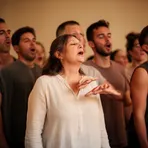
A slow, steady sound that repeats like people singing the same short words

Said or sung in a steady voice like a chant

Said or sung with a regular beat, often by a group
Antonyms


How Rhythmic

Surface Forms
Morphology
Etymology
Singsong comes from the words sing and song, so it brings to mind a musical, rhythmic sound. That's why singsong can describe a voice that sounds like a simple song, often with a chantlike rhythm.