

silicon carbide
- noun
- /ˈsɪlɪkən ˈkɑːrbaɪd/
- Specialized
- Both methods use small (less than 5 µm) abrasive particles, such as alumina, silicon carbide, or diamond.
- silicon carbide ceramic
- silicon carbide materials
- nitride and silicon carbide
Examples
-
It features a high-pressure, silicon carbide oil bath mechanical seal design that allows for totally dry running for indefinite time periods.
Academic text (1997) -
Moreover, GaAs and silicon carbide have even greater gaps than silicon, and the mobility of electrons in GaAs is even higher than that of electrons in germanium.
Academic text (1997) -
So you can see the silicon carbide here is a refractory material.
-
Many applications also exist for silicon carbide materials developed primarily for turbine engine programs.
Academic text (1997) -
Early reaction-sintered silicon carbide materials had strength that was similar to RBSN and superior oxidation resistance.
Academic text (1997) -
If we use silicon carbide for the primary mirror instead of glass, the telescope will weigh a mere 9,000 tons," says Gilmozzi.
Academic text (2002) -
Sintered silicon nitride and silicon carbide materials were developed in the late 1970s and became the primary candidates for turbine programs throughout the 1980s.
Academic text (1997) -
Interest was renewed in ceramics for turbines when new materials in the silicon nitride and silicon carbide families of ceramics were developed during the 1960s.
Academic text (1997) -
The fact that phonons are easily transmitted in a stiff lattice of light atoms means that materials made up of carbon, boron, and silicon carbide are excellent thermal conductors.
Academic text (1999) -
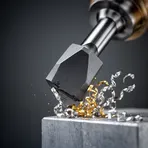
Using silicon carbide as an abrasive in cutting tools enhances their lifespan due to its extreme hardness.
Synonyms
 8
7.5
8
7.5

A hard material made from carbon and another element used for cutting tools
How Abrasive

Surface Forms
Morphology
The term is a straightforward chemical compound name formed compositionally from 'silicon' + 'carbide', so a learner who knows both nouns can infer it denotes a carbide containing silicon (a silicon–carbon material). While detailed technical properties (hardness, color, semiconductor uses) are specialist knowledge, the basic meaning as a material compound is transparently derivable from the constituents.
Etymology
Silicon carbide is a name that tells you what it is: silicon and carbon joined to make tiny blue-black crystals that look like very hard, sharp stones. Picture those sharp crystals — that's why the material is used to cut and grind things and to resist high heat in electronics.