
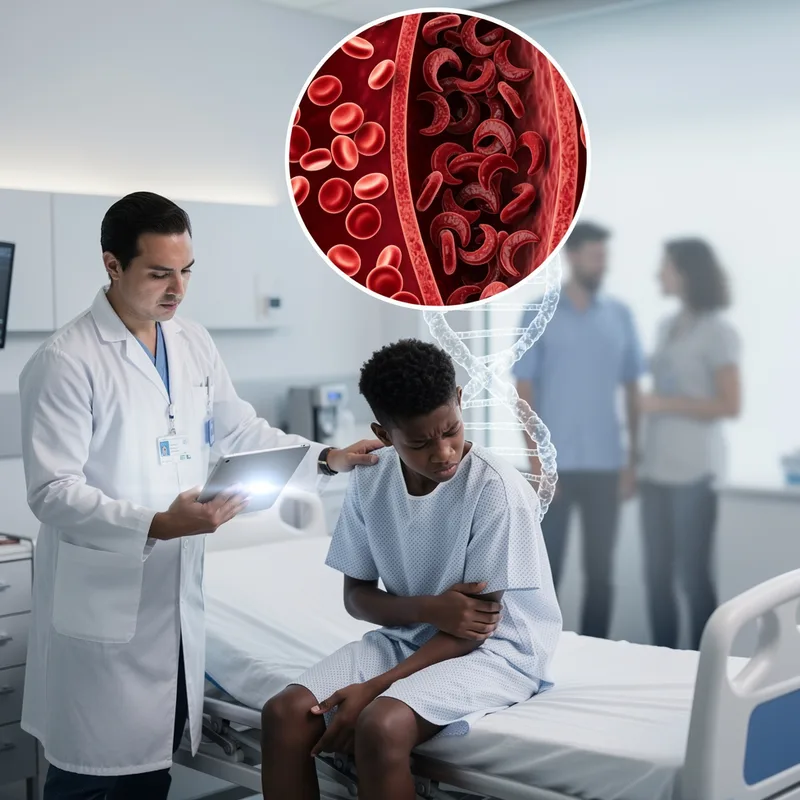
sickle-cell disease
 1
3.4
1
3.4

- noun
- /ˈsɪkəl sɛl dɪˈziːz/
- Specialized
- Research with blood stem cells is being used to treat leukemia and other blood diseases such as thalassemia and sickle cell disease.
- sickle-cell disease patients
Examples
-
In the United States, actual sickle cell disease occurs in approximately 1 in every 500 African American babies, and 1 in 12 carry the SCT.
Academic text (2003) -
For adolescents with sickle cell disease (SCD), adolescence is complicated by the physical, social, and psychological stresses of living with a chronic illness.
Academic text (2000) -
A baby with sickle cell disease is at risk for harmful infections.
Blog text (29) -
Children with asthma and sickle cell disease had a higher risk of depression compared to children with other disorders such as diabetes or cancer.
Academic text (2011) -
Sickle cell disease is a lifelong autosomal recessive disorder.
Academic text (2003) -
Hispanic Americans are also at risk, with approximately 1 in every 1,000 to 1,400 babies diagnosed with sickle cell disease (American Sickle Cell Anemia Association, 2003).
Academic text (2003) -
Support groups have the potential to mitigate some of the developmental and condition-specific psychological and social issues common to sickle cell disease (SCD), yet little is known about how adolescents with SCD view and use these groups.
Academic text (2000) -
Sickle-cell disease is a serious condition that causes severe pain and fatigue due to abnormal sickle-cell disease.
-
Many people with sickle-cell disease must visit the hospital frequently for treatment and pain management.
-
Research shows that individuals with sickle-cell disease often face complications such as chronic pain and increased risk of infections.
Synonyms
 3
4.1
3
4.1
An inherited blood illness in which red blood cells become crescent shaped, causing low red blood cell count and pain

A blood disease you are born with in which red blood cells become sickle-shaped and cause tiredness and pain

An inherited blood disease in which red blood cells become crescent-shaped and break early, causing pain and tiredness
Surface Forms
Morphology
sickle-cell + disease
The term is compositionally transparent: 'sickle-cell' describes cells shaped like a sickle and 'disease' denotes a medical condition, so a learner who knows both constituents can infer it is a disease involving sickle-shaped blood cells (i.e., a form of anemia). Specific details about heredity and prevalence among certain populations are additional encyclopedic facts, but the core meaning is directly derivable from the parts.
Etymology
Sickle-cell disease gets its name from the look of some red blood cells, which become curved like a farmer's sickle instead of round. Because these curved cells can block blood flow and cause pain and a 'low blood count', the name now refers to a blood problem that 'runs in families'.