
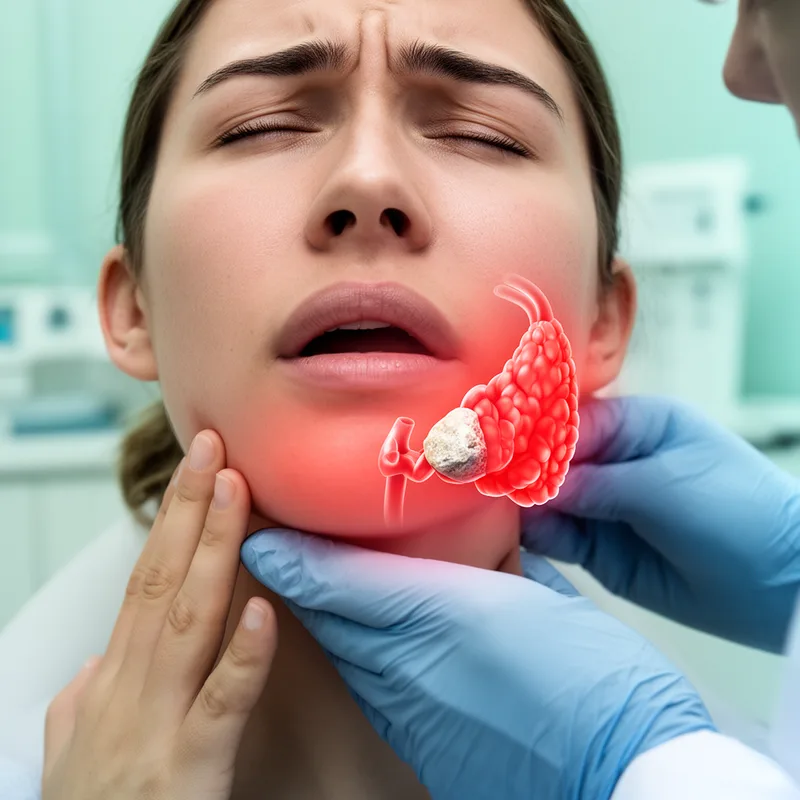
sialadenitis
- noun
- /ˌsaɪəˌlædəˈnaɪtɪs/
- Specialized
- Chronic sialadenitis can cause painful swelling in the affected salivary glands.
- chronic sialadenitis
- xanthogranulomatous sialadenitis
- cases of sialadenitis
Examples
-
The doctor explained that sialadenitis often occurs as a result of infections or salivary stones.
-
After experiencing symptoms for weeks, he was diagnosed with sialadenitis due to a blockage.
-
There was no history of past episodes of sialolithiasis or sialadenitis.
Academic text (1996) -
Table: Comparison of the 3 reported cases of xanthogranulomatous sialadenitis.
Academic text (2005) -
All three reported cases of xanthogranulomatous sialadenitis have two significant factors in common (table).
Academic text (2005) -
We compare the features of this case with those of the two previously reported cases of xanthogranulomatous sialadenitis, and we discuss its possible etiologies.
Academic text (2005) -
The reporting of additional cases of xanthogranulomatous sialadenitis may help elucidate the mechanism of its development.
Academic text (2005) -
Two fine-needle aspiration cytologies showed inflammatory changes compatible with chronic sialadenitis.
Academic text (2001) -
She had previously been treated for chronic sialadenitis with a sialodochoplasty and a dilation of Stensen's duct.
Academic text (2001) -
Xerostomia can lead to dysgeusia, glossodynia, sialadenitis, cracking and fissuring of the oral mucosa, and halitosis.
Academic text (1999)
Surface Forms
Morphology
sialadenitis = adenitis (opaque) = sial + aden + itis
While the components 'aden' and 'itis' are recognizable, the prefix 'sial' is not a standalone English word, making the term opaque for most learners.
Etymology
Sialadenitis comes from three parts: sial 'saliva', aden 'gland' and -itis 'inflammation'. So, it means inflammation of the salivary glands, which is why the word is used for a swollen or infected salivary gland.

