
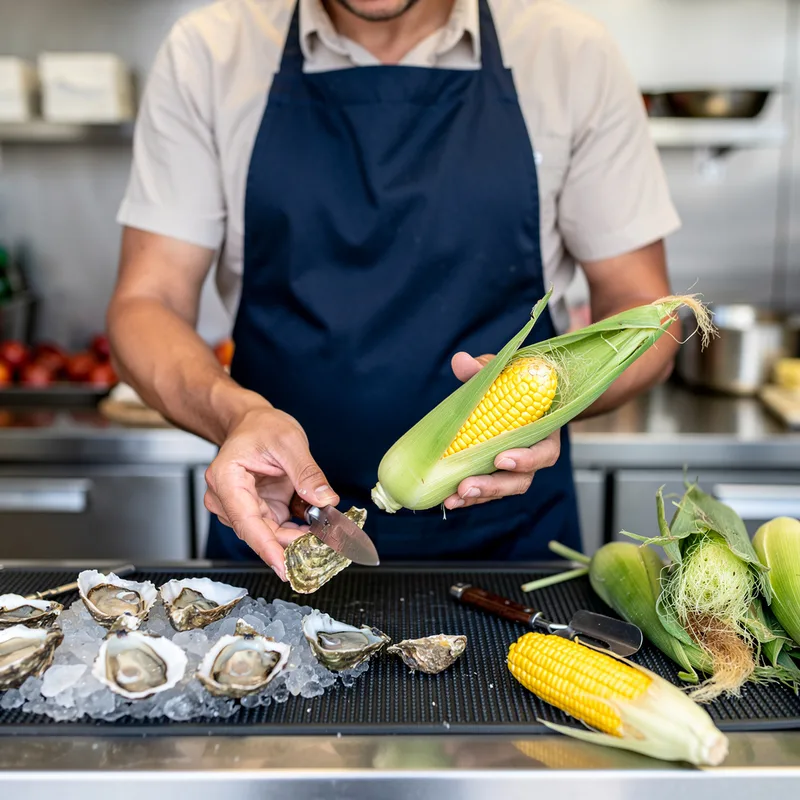
shucker
 1
6.5
1
6.5

- noun
- /ˈʃʌkər/
- The shuckers also saved some pea crabs to eat at home in oyster stews or fritters (Anderson13).
- oyster shuckers
Examples
-
Individual shuckers had their own favorites.
Academic text (1996) -
In some packing houses, tokens were given to shuckers when a predetermined quantity of oysters was shucked.
Academic text (1996) -
Individual shuckers often got about half a teacup per day.
Academic text (1996) -
Each shucker is equipped with a gallon bucket, a thin-bladed knife, a hammer, and a breaking block.
Academic text (1996) -
The shuckers can then easily insert the blade to sever the muscle.
Academic text (1996) -
The baskets carry oysters to the shuckers, keeping them supplied.
Academic text (1996) -
Good shuckers can open about 20-25 bushels (4,000-5,000 oysters) a day.
Academic text (1996) -
The shuckers were paid at the rate of $0.18-$0.20 per gallon of meats opened (Anonymous, 1906c).
Academic text (1996) -
As the oysters were being opened, the shuckers set aside the pea crabs and gave them to the workers in the houses' packing rooms; the workers sold them to the Fulton Market in New York.
Academic text (1996) -
An experienced shucker can open dozens of oysters in just a few minutes.
Synonyms
 1
5.6
1
5.6
A person or machine that pulls things off, like feathers
 1
5.8
1
5.8
A person or machine that removes the outer covering of peas

A person who removes the outer leaves from ears of corn

A machine that removes the outer covering from seeds or grains
A person who opens hard shells of nuts or shellfish for food
Surface Forms
Morphology
Etymology
The word shucker comes from the verb shuck, which means 'to remove a shell or husk', so a shucker is someone or something that takes shells off oysters or husks off corn.