
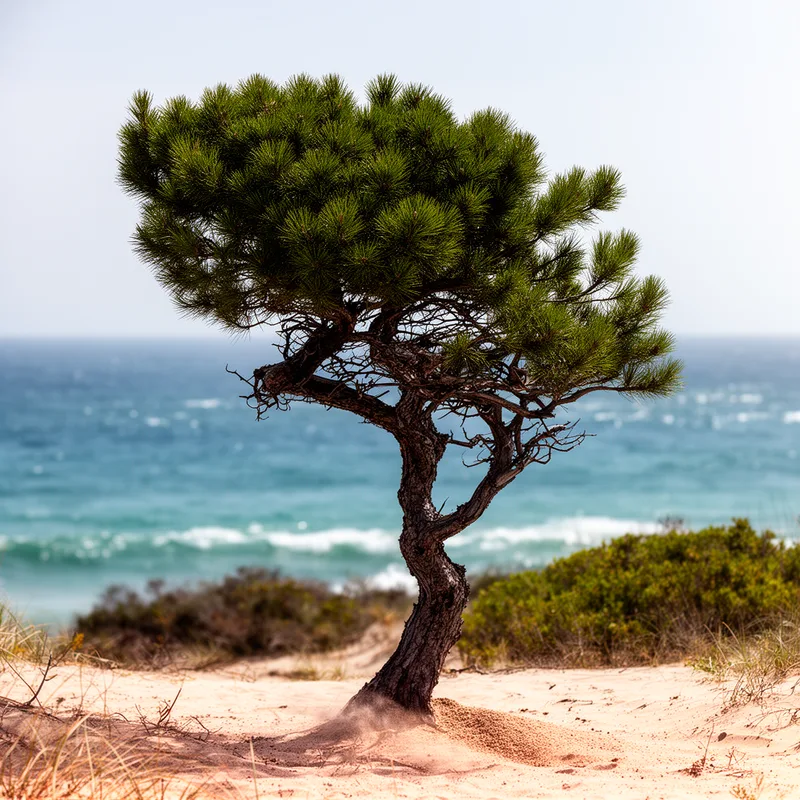
shore pine
- noun
- /ʃɔr paɪn/
- Specialized
- She planted a shore pine in her coastal garden for its resilience to salty air.
Examples
-
The twisted branches of the shore pine are a common sight along the Oregon coast.
-
The shore pine grows abundantly along the coast.
-
Native shrubs and shore pine help stabilize the sandy dunes near the shore.
-
Many shore pines can be found in Oregon.
-
The shore pine is commonly found along the coastal areas of the northwestern United States.
-
In the forest, the shore pine stands out with its distinctive red-brown bark and unique needle clusters.
-
Many gardeners appreciate the shore pine for its shrubby appearance and resilience to coastal winds.
Synonyms

 3
9.9
3
9.9

A pine tree with two needles in each cluster that grows in western North America
A pine tree from the northwest coast of North America with needles in pairs and reddish scaly bark

A small shrubby evergreen with two needles per group and scaly square bark
Surface Forms
Morphology
The meaning is directly compositional: combining 'shore' (land at the edge of water) with 'pine' (a type of evergreen tree) yields a pine associated with the shore. This noun–noun compound names a literal botanical type/location, a common and cross-linguistically transparent pattern that a B1 learner who knows both words can readily infer.
Etymology
Shore pine comes from a simple image: a pine tree growing right on the shore, with wind and salt twisting its branches. So the name tells you it is a tough 'pine' that lives 'by the sea'.