

shapeshifting
 2
8.4
2
8.4

- noun
- /ˈʃeɪpˌʃɪftɪŋ/
- Literature
- The story revolves around a shapeshifting creature that can adapt its form to blend into various environments.
Examples
-
Barnouw emphasizes that human-animal shapeshifting is not a trope or literary device.
Academic text (1997) -
Immediately after this death, the first shapeshifting occurs.
Academic text (1997) -
This merging of human and animal forms is known as shapeshifting.
Academic text (1997) -
Shapeshifting was the medieval art of borrowing somebody else's body to live in for a while.
-
Shapeshifting requires, among other things, surrendering one's exclusively human nature, which is characterized by analytic thought.
Academic text (1997) -
But the fullest interpretation of certain texts by Chippewa authors will only yield itself when we accept shapeshifting as part of the human repertoire.
Academic text (1997) -
In folklore, shapeshifting often involves a character transforming into an animal to explore the world from a different perspective.
-
Many myths feature shapeshifting as a way for gods to interact with humans in disguise.
Synonyms
 241
3.7
241
3.7
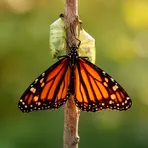
A complete change in form or appearance, for example a caterpillar becoming a butterfly
 12
2.0
12
2.0
Changing something into a different form or appearance
 9
7.5
9
7.5
A complete sudden change that makes someone or something very different
 3
8.6
3
8.6
A change of something into a different form
 1
9.9
1
9.9
A change into a strange or ugly new form
 1
9.0
1
9.0
A big change in appearance that makes something more beautiful or special

The way something becomes a different form when it is bent, heated, or pressed

The state of having many different forms or shapes
How Complete

Surface Forms
Morphology
Etymology
Shapeshifting is the name for the act or power of changing form, made from shape ('form') and shift ('change'). You often find shapeshifting in myths and stories where people or animals become other beings.