
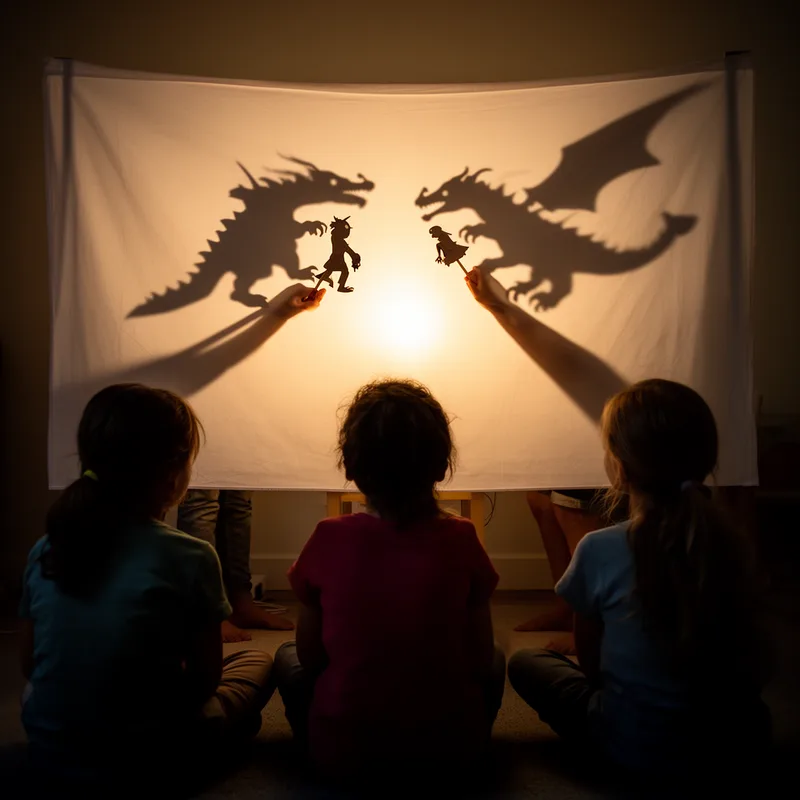
shadow play
 1
7.4
1
7.4

- noun
- /ˈʃædoʊ pleɪ/
- Between 1965 and 1967, Jacobs developed two other shadow plays, presented as chapters in what became the four-part series, The Big Blackout of '65.
- shadow play performance
- early shadow plays
- first shadow play
Examples
-
Between 1965 and 1982, Jacobs developed at least twelve new shadow play performances.
Academic text (2017) -
The troupe has been rehearsing a new shadow play.
-
Since then, he has presented only two further shadow plays, both of which combined sequences from earlier performances.
Academic text (2017) -
As we might expect, the contexts in which the shadow plays were presented very much determined who wrote about them and how they were viewed.
Academic text (2017) -
In fact, Jacobs presented two shadow plays at the festival: one for the regular festival program and another for an audience of children.
Academic text (2017) -
An old Dutch building is now a puppet museum featuring Javanese shadow plays and gamelan music.
Academic text (1993) -
The children watched a fascinating shadow play performed by their classmates during the school festival.
-
In the evening, the theater showcased an enchanting shadow play that captivated the entire audience.
-
At the cultural fair, a group demonstrated shadow play using puppets to tell traditional stories.
Synonyms
A performance that uses figures and light to make moving shadows on a screen
A performance that shows moving shadow figures on a screen
How Elaborate
 1
7.4
1
7.4
Surface Forms
Morphology
The compound 'shadow play' is compositionally transparent: it denotes a 'play' that uses 'shadows', so the overall meaning can be directly inferred from the constituent nouns. This noun–noun compounding pattern is cross-linguistically common (e.g., Chinese 影戏, Spanish teatro de sombras, Turkish gölge oyunu), so a B1 learner who knows 'shadow' and 'play' would very likely understand it.
Etymology
Shadow play comes from simple shows where performers stand behind a screen and shine a light to make dark shadows with their hands, figures, or puppets. Those moving dark shapes told stories, so shadow play today means a kind of drama that uses shadow pictures to tell a story.