
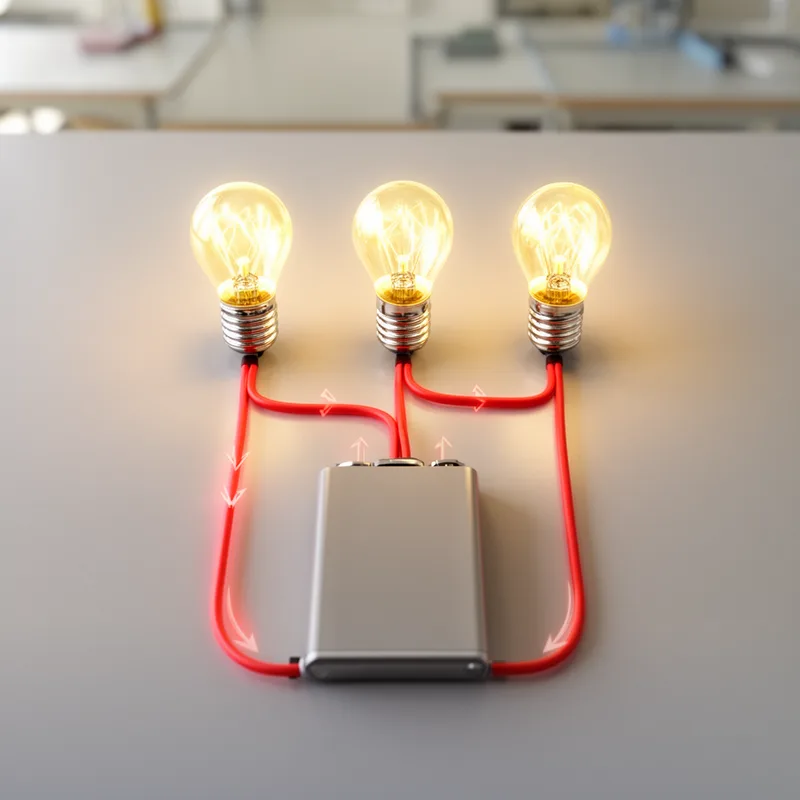
series circuit


 1
3.9
1
3.9
- noun
- /ˈsɪriz ˈsɜrkɪt/
- Specialized
- When building a series circuit, ensure that each device is properly connected to maintain a consistent flow of electricity.
Examples
-
Like the one time you explained to Tina Mengacchi about series circuit resistance in physics?
-
One could design a parallel circuit to do the same thing as a series circuit; the voltage and amps are identical.
Blog text (31) -
For example, if there were three 9V batteries with the terminals connected negative to positive, negative to positive, and negative to positive, they would form a series circuit, and the total voltage would add up to 18V.
Academic text (2011) -
In a series circuit, the same current passes through all the components connected one after another.
-
If you connect the batteries in a series circuit, the voltage increases while the current remains the same.
Synonyms
 49
5.7
49
5.7
A connection of electrical parts joined so the current flows through each
Antonyms

- Specialized
1
4.3
A closed path for electricity that splits into branches so devices work independently
How Parallel

Surface Forms
Morphology
The meaning is directly compositional: 'series' (items arranged one after another) + 'circuit' (route for electric current) yield an electrical circuit with components connected in sequence so the same current flows. Although technical, this construction follows standard noun + noun compounding and mirrors equivalents in many languages, so a B1 learner who knows the constituents will understand the MWE.
Etymology
Series circuit puts parts in a series, one after another, along a single circuit, like bulbs on an old string of Christmas lights. Because the current must pass through every part in that one path, if one bulb fails the whole string goes out, so it means 'a single path for the current'.