
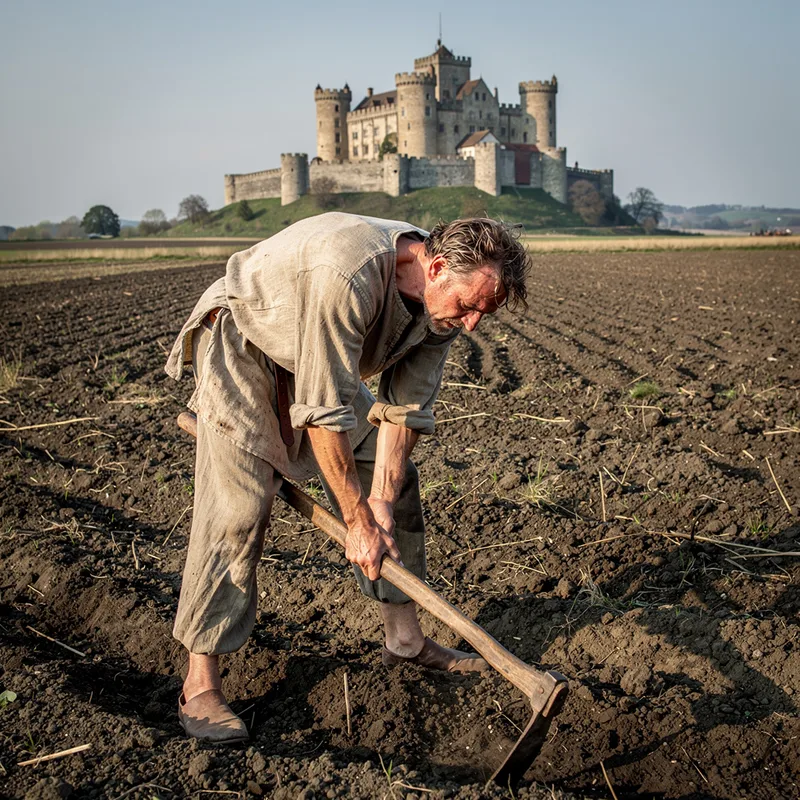
serf
 19
9.4
19
9.4

- noun
- /sɜrf/
- In rural areas during the Middle Ages, many families lived and worked as serfs on the lord's estate.
- serfs and slaves
- serfs on landowners
- peasant serf
Loading YouTube…
Watch on YouTubeOr you can stay, but you'll be serfs.
- Or you can stay, but you'll be serfs.
- So for example, a feudal Manor would start to disintegrate, serfs would run away, then run into a town.
- The western part is more Polish oriented, Catholic and with Lords living close to their serfs.
- The other becomes the serf, the slave, the servant, the Kinect.
- It's the kind of yearning slaves had to go beyond slavery or serfs to go beyond feudalism.
- So did this, did this serfs belong to the Muscovite state, Right.
- I'm going to start thinking that my father can't help himself, that he was born a serf and he's been bred to be this awful person.
Examples
-
These are the plains men, these are the serf class who gradually work their way into the Polish.
-
We are not serfs, general, nor mercenaries.
-
So they pay folk from serf backgrounds a bit extra to help them manage the rest.
Fiction book (2002) -
The Lord's a small number, the serfs a very large number.
-
Finally, hundreds listened, thousands, who took up his call for the rights of all ranks from baron to serf.
-
Were you serious about renting your land to the serfs?
-
Can't expect an Irish serf to forget the habits of a lifetime, now.
-
My father was one of your father's serfs, and your grandfather's serf before that.
-
Before Cornell, all serfs had the right to cultivate specific portions of the land.
Academic text (1996) -
I'm Indy Nydell, the son of a serf that rose to the lower nobility in Imperial Russia.
Synonyms

 1
9.9
1
9.9
A person in the Middle Ages who must work the lord's land and cannot leave

A person forced to work without pay for someone else
Antonyms

How Free
- Archaic
 ∞
1.4
248
3.0
19
9.4
∞
1.4
248
3.0
19
9.4
- Archaic
746
3.4
Surface Forms
Etymology
The word serf comes from the Latin word servus, which means 'slave'. Like the modern words serve and servant, a serf was someone tied to the land and forced to work for a lord, often unable to leave without permission.