
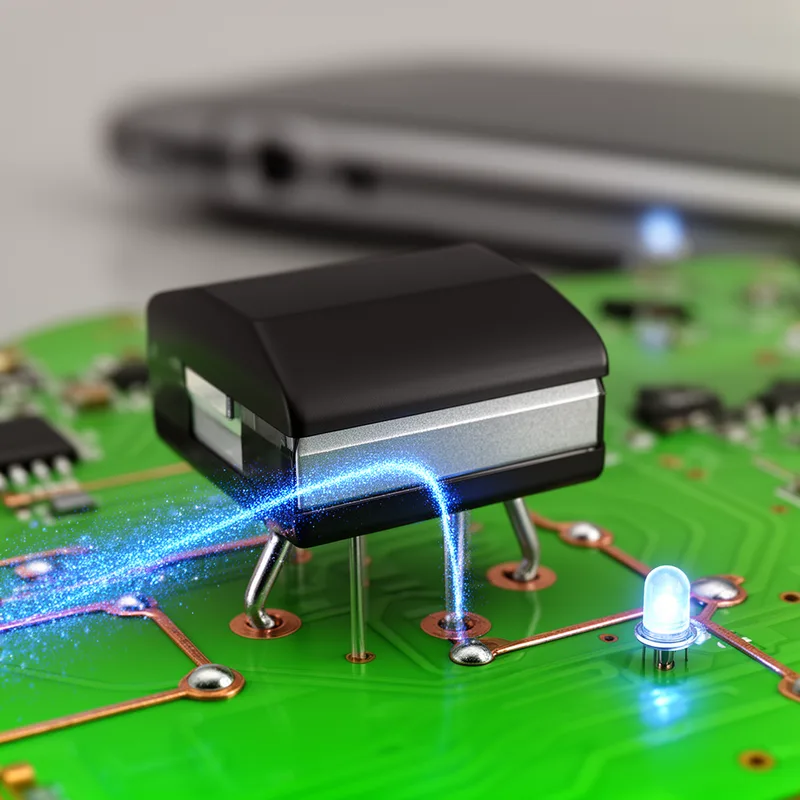
semiconductor device


 1
4.0
1
4.0
- noun
- /ˌsɛmɪˈkɒndʌktər dɪˈvaɪs/
- Specialized
- Engineers are creating advanced semiconductor devices that can operate at higher temperatures than traditional materials.
Loading YouTube…
Watch on YouTubeThere are LEDs or semiconductor devices which provide photons with interesting statistical properties.
- There are LEDs or semiconductor devices which provide photons with interesting statistical properties.
Examples
-
Advances in lithographic imaging techniques and materials have played a key role in the remarkable evolution of semiconductor devices and circuits, where the continuing drive toward miniaturization has led to improved performance and lower costs.
Academic text (2001) -
There are LEDs or semiconductor devices which provide photons with interesting statistical properties.
-
Semiconductor device development has not been slowed as yet by physical limits but rather by economic ones.
Academic text (1993) -
The transistor was not the first semiconductor device, nor was silicon the first semiconductor material of choice.
Academic text (1997) -
Flash memories are the most promising of the nonvolatile semiconductor devices, although they have many practical drawbacks.
Academic text (1995) -
We expect that further development of semiconductor devices with low dark currents will allow tritium betavoltaics to approach the Q = 70% line.
Academic text (2012) -
The laser market has developed along a curve that mimics the development of the market for semiconductor devices and chips, with a time lag of roughly 17 years.
Academic text (1993) -
The device itself was invented in 1960, became a major element in computer memories by 1972, and is now the dominant active (or amplifying) semiconductor device.
Academic text (1993) -
A quantum leap in efficiency promises to come from the light-emitting diode, a solid-state semiconductor device that emits a bright light and has twice the efficiency and ten times the lifetime of CFLs.
Academic text (1999) -
The new generation of semiconductor devices plays a crucial role in modern electronics by regulating electrical flow efficiently.
Synonyms
A small part made from a material that controls electric current in electronic devices
Antonyms


How Conductive
- Specialized
1
8.0

- Specialized
8
4.8
- Specialized
1
4.0
- Specialized
5
4.7
Surface Forms
Morphology
The meaning is directly compositional: a 'semiconductor device' is simply a 'device' made from a 'semiconductor' material, so a learner who knows both constituent meanings can derive the compound sense. This noun–noun compounding pattern is regular and cross-linguistically common, making the expression transparent despite its technical register.
Etymology
The name semiconductor device comes from materials that are partly a conductor and partly an insulator, because semi means 'partly'. Imagine a part that lets electricity through sometimes and blocks it other times. That 'in-between' ability to control electricity is why the phrase means an electronic component used in circuits.