
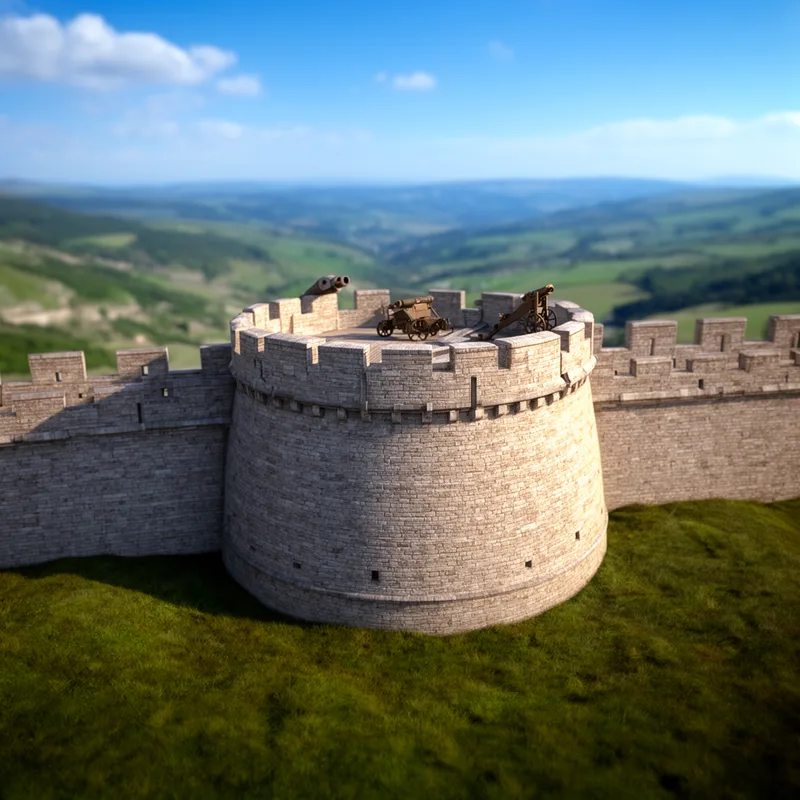
semi-circular bastion
- noun
- Specialized
- Engineers abandoned the semi-circular bastion design in favor of more angular fortifications.
Examples
-
Many semi-circular bastions were built in the 16th century.
-
The old fortress still stands, featuring a prominent semi-circular bastion overlooking the valley.
-
Archaeologists studied a ruined semi-circular bastion dating back to the Elizabethan era.
-
The fortress featured a semi-circular bastion for defense.
-
The old fortress still stands, featuring a prominent semi-circular bastion overlooking the valley.
-
Engineers abandoned the semi-circular bastion design in favor of more angular fortifications.
-
Archaeologists studied a ruined semi-circular bastion dating back to the Elizabethan era.
Synonyms

 5
8.3
5
8.3

A strong part of a fort that sticks out for protection

A curved part of a fort wall shaped like a half moon for defenders to fire on attackers
Surface Forms
Morphology
semi-circular + bastion
The noun phrase is compositionally transparent: 'semi-circular' describes the shape (half-circle) and 'bastion' names a defensive projection, so the combined meaning 'a bastion that is semicircular in shape' is directly derivable from the parts. This follows a common adjective+noun pattern found across languages, so a B1 learner who knows the constituent meanings would readily understand the MWE despite any historical detail in the full definition.
Etymology
Semi-circular bastion comes from old fort design: a bastion is a part of a wall that sticks out and semi-circular means a 'half circle', so picture a half-round projection standing away from the main wall. That's why the term names a curved defensive work used in old forts, later replaced because it did not work well against guns.