

semelfactive verb
- noun
- /ˈsɛməlˌfæktɪv vɜrb/
- Specialized
- Linguists classify 'sneeze' as a semelfactive verb since it represents one event rather than a repeated action.
Examples
-
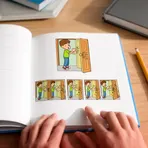
The verb 'knock' is often considered a semelfactive verb because it refers to a single act.
-
A semelfactive verb describes an action that occurs just once.
-
In language studies, a semelfactive verb is contrasted with one that shows habitual or continuous action.
-
In English, the word 'knock' is a semelfactive verb.
-
Linguists classify 'sneeze' as a semelfactive verb since it represents one event rather than a repeated action.
-
In language studies, a semelfactive verb is contrasted with one that shows habitual or continuous action.
-
The verb 'knock' is often considered a semelfactive verb because it refers to a single act.
Antonyms


How Often

Surface Forms
Morphology
semelfactive + verb
The modifier 'semelfactive' is a specialist linguistic term (derived from Latin roots) that an average B1 learner would not know or be able to parse, while 'verb' only supplies the syntactic category. Because the crucial meaning 'occurs once' depends on technical morphological knowledge rather than transparent everyday words or composition, the overall phrase is not derivable from its parts for typical learners.
Etymology
The term semelfactive verb comes from language study and labels verbs that describe an action happening just once. Think of a single sneeze or one knock on a door, these verbs show one event, not something repeated, so the term means 'an action that happens once'.