
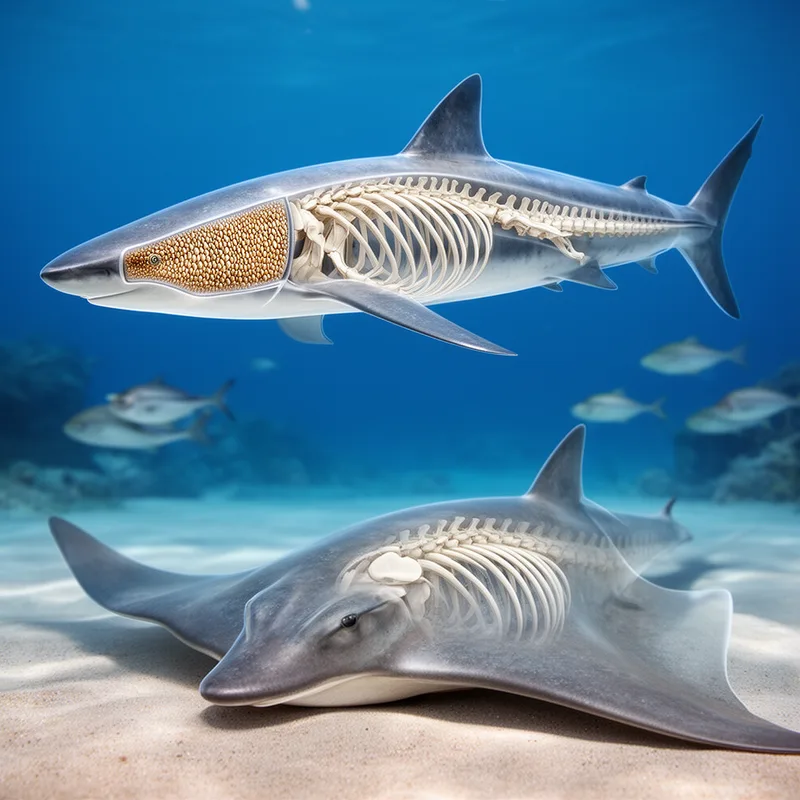
selachian
- noun
- /sɪˈleɪkiən/
- Specialized
- Many selachian species, such as sharks and rays, play a crucial role in ocean ecosystems.
Examples
-
Unlike bony fishes, selachians have skeletons made almost entirely of cartilage.
-
The fossil record shows that selachians have existed for over 400 million years.
-
The selachian species are fascinating to study.
-
Many selachians inhabit the ocean depths.
-
Many selachian species, such as sharks and rays, play a crucial role in ocean ecosystems.
-
Unlike bony fishes, selachians have skeletons made almost entirely of cartilage.
-
The fossil record shows that selachians have existed for over 400 million years.
Synonyms
A fish with a skeleton made of cartilage like a shark or ray
A group of fish with skeletons made of cartilage, like sharks and rays
A group of fish like sharks, rays, and skates with skeletons made of cartilage

A fish whose skeleton is made of soft cartilage not bone
Surface Forms
Morphology
selachian = selach + ian
The combining form 'selach-' is not a standalone English word and its meaning ('shark') is not transparent to an average B1 learner, so the term is not clearly derivable from familiar components despite the regular '-ian' suffix.
Etymology
The word selachian comes from the Greek word selachē, meaning 'shark'. So selachians are the shark-like fishes — sharks, rays and skates — with skeletons made of cartilage, the soft, bendy tissue in your nose and ear.

