

seed corn


 1
4.1
1
4.1
- noun
- /siːd kɔrn/
- Specialized
- Because this fungus seldom appeared on corn in the United States, corn breeders did not think resistance to the fungus was an important trait to select for in breeding seed corn.
Examples
-
It was seed corn and not field corn, but we spent our spring, summers, and falls in the fields or in the corn nursery.
Blog text (12) -
The agriculture team focused on improving the quality of seed corn for better yields.
-
Our fields are ready for planting but we've no seed corn.
-
My mothers had brought seed corn from the Five Villages and squash, bean, and sunflower seed.
Academic text (1992) -
I think I might have mentioned this to you before, but my dad managed the research farm for a fairly good-sized seed corn company, so corn was our livelihood when I was growing up.
Blog text (12) -
Farmers select the best seed corn to ensure a strong harvest next year.
-
Before planting, they tested the seed corn for germination rates to ensure success.
Synonyms
 1
3.6
1
3.6
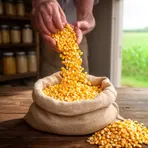
Seeds or tubers that farmers keep to plant next year's crops
 1
3.4
1
3.4
Kernels of crops like corn that farmers keep to plant next season
Surface Forms
Morphology
The noun–noun compound is compositionally transparent: 'seed' modifies 'corn' to indicate corn kept for sowing, so a B1 learner who knows 'seed' (used for planting) and 'corn' can infer 'corn reserved for future planting.' The extended metaphorical meaning (resources set aside for future growth) follows directly from this literal agricultural practice and is a common, cross-linguistic analogy, making the expression readily comprehensible.
Etymology
Seed corn comes from farmers who set aside the best seed or corn kernels to plant the next year instead of eating them, so it means grain saved to 'grow' the next crop.