
secondary modern school
- noun
- /ˈsɛkəndəri ˈmɒdərn skuːl/
- Archaic
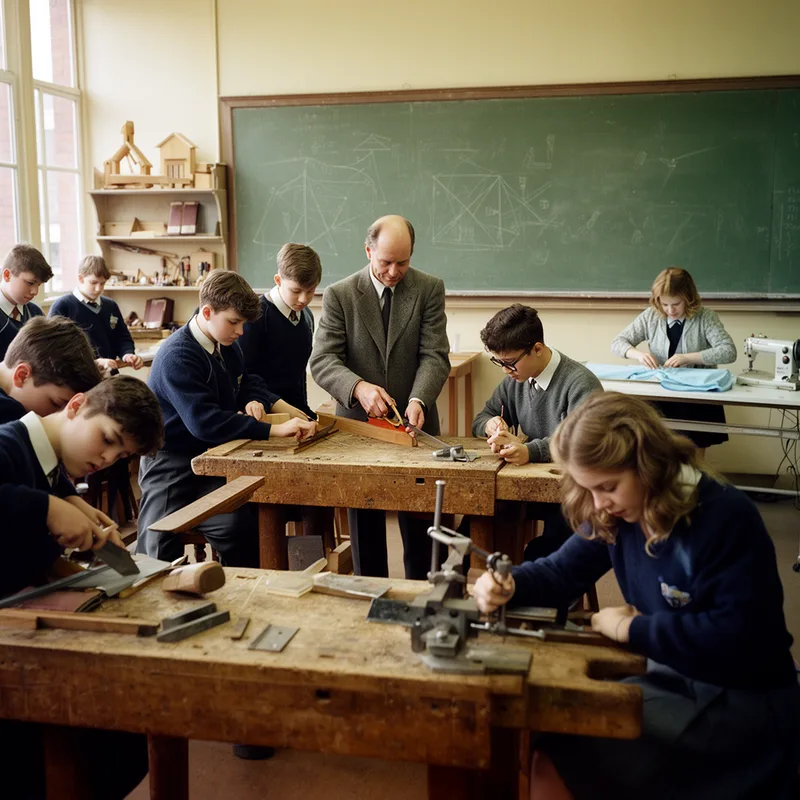
- At the secondary modern school, students learned practical trades such as carpentry and plumbing.
Loading YouTube…
Watch on YouTubeAnd it wasn't really until I went to secondary modern school because I was not academic.
- And it wasn't really until I went to secondary modern school because I was not academic.
Examples
-
Similarly, there were very few boys with externalizing behavior in the academically elite private/grammar secondary schools, while such boys were slightly overrepresented in the vocationally oriented secondary modern schools.
Academic text (1993) -
The first-ever public testing of school students was conducted there in 1850 (Lindgren 1990; College 1856) when over 20,000 secondary modern school pupils were examined (Chapman 1985).
Academic text (1993) -
And it wasn't really until I went to secondary modern school because I was not academic.
-
Many students who struggled with traditional subjects flourished in a secondary modern school that emphasized hands-on skills.
-
The secondary modern school provided an alternative education path for those interested in vocational training.
Synonyms

 5
3.0
5
3.0

A school where students learn practical skills for a specific job
Surface Forms
Morphology
Knowing 'secondary' + 'modern' + 'school' lets a learner infer this is a kind of secondary school with 'modern' as a modifier, so the basic compositional structure is clear. However, the specific historical British sense (a former vocational rather than academic school) is conventional and not predictable from the parts, so learners will likely misinterpret it as merely a 'modern' secondary school.
Etymology
Secondary modern school was a name used in Britain after a test called the 'eleven-plus'. Children who did not pass went to a secondary modern school that taught practical, everyday skills instead of academic ones, so the name came to mean a school for training for trades and 'practical' work.