
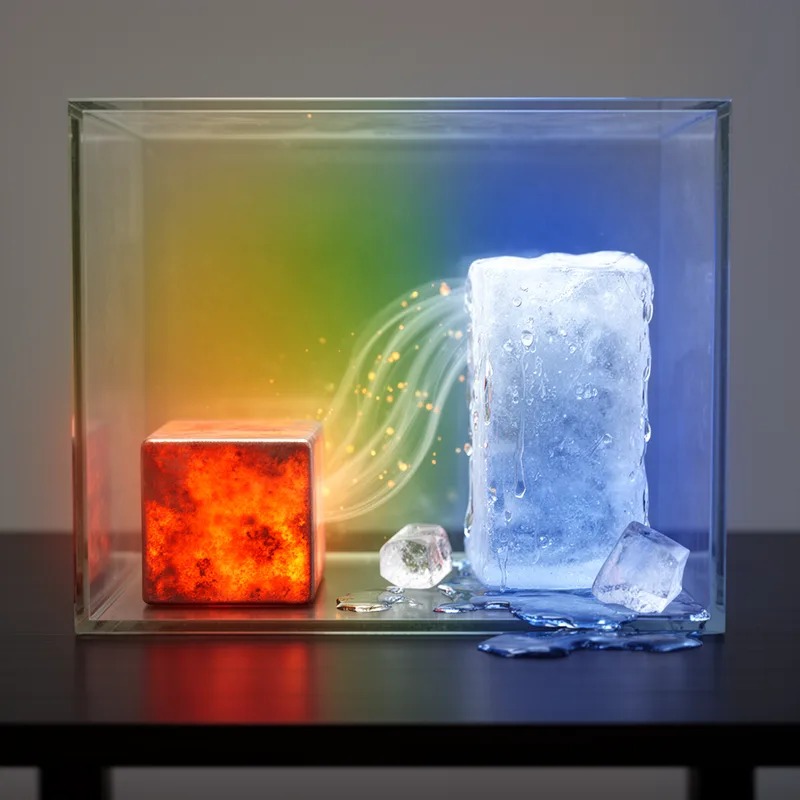
second law of thermodynamics
 4
7.0
4
7.0

- noun
- /ˈsɛkənd lɔː əv ˌθɜrməˈdaɪnəmɪks/
- Specialized
- In physics, this is described by the second law of thermodynamics, which says that systems will gain disorder or entropy over time.
Loading YouTube…
Watch on YouTubeAs you may know, the entire world operates on a universal law, entropy, the second law of thermodynamics.
- As you may know, the entire world operates on a universal law, entropy, the second law of thermodynamics.
Examples
-
We can't allow ourselves to obey the second law of thermodynamics, which states that in any natural process, entropy will always increase.
-
According to the second law of thermodynamics, things fall apart.
Blog text (23) -
But if your theory is found to be against the second law of thermodynamics,
Academic text (2004) -
There is plenty of evidence for the second law of thermodynamics.
Blog text (26) -
According to the second law of thermodynamics, almost everything, including a man, returns to its natural state: dust.
Blog text (25) -
There is, however, a fundamental law of physics, called the second law of thermodynamics, which places strong constraints on what can be achieved by a cyclic physical process.
Academic text (1992) -
The second law of thermodynamics explains why heat flows from hot to cold objects.
-
According to the second law of thermodynamics, energy tends to disperse and spread out.
-
The second law of thermodynamics indicates that entropy in an isolated system will always increase over time.
Surface Forms
Morphology
2nd + law + of + thermodynamics
The phrase is compositionally regular: a learner who knows 'second', 'law' and 'thermodynamics' can infer this refers to the second scientific principle within the field of thermodynamics. However, the specific content (the entropy increase and detailed behaviour of energy/heat) is technical domain knowledge and not predictable from the common-word meanings alone, so the meaning is only partly transparent.
Etymology
Second law of thermodynamics comes from early people who built steam engines and saw that heat always moved from 'hot to cold' and that engines always lost some energy. That's why the law says 'energy spreads out' and things tend toward more 'disorder', so no machine can be 100% efficient.