

seagrass
 2
5.4
2
5.4

- noun
- /ˈsiːˌɡræs/
- Dugongs feed primarily on seagrass, which grows in shallow coastal waters.
- seagrass meadows
- seagrass beds
- seagrass habitat
Loading YouTube…
Watch on YouTubeIt's sharks are needed to control certain populations that might eat seagrass or kelp beds, which are important for reabsorption of carbon.
- It's sharks are needed to control certain populations that might eat seagrass or kelp beds, which are important for reabsorption of carbon.
Examples
-
Relatively large expanses of seagrass meadows still remain, and mangrove trees line much of the shoreline.
Academic text (1992) -
From 1951 to 1992, the total seagrass coverage in Waquoit Bay has decreased substantially.
Academic text (2003) -
Reported seagrass losses have led to increased awareness of the need for seagrass protection, monitoring, management, and restoration.
Academic text (2006) -
So seagrass actually stores more carbon than rainforests.
-
Transplant experiments indicate that most seagrass beds, in fact, cannot support juvenile conch.
Academic text (1997) -
Although our primary focus here is on the seagrasses themselves, seagrass-associated species are also threatened or vulnerable to extinction.
Academic text (2006) -
Our reevaluation of seagrass dispersal and recruitment has altered our fundamental understanding of seagrass resilience in several ways.
Academic text (2012) -
Based in Beaufort, I check the population of seagrasses in the shallow, well-travelled waters around the Outer Banks.
Fiction book (1999) -
Clouds of algae streak the surface of deep waters, and in shallower regions, large seaweeds and seagrass cover the ground.
-
The dugong is happily munching away on seagrass around a reef ecosystem, a coastal ecosystem, a seagrass meadow or wherever.
Synonyms
 1
8.1
1
8.1
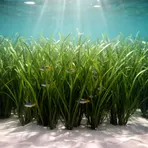
A long plant with narrow leaves that grows underwater and forms meadows for fish

A sea plant with long narrow leaves that grows underwater and forms beds where fish and small animals live

Long underwater plant with thin leaves that grows near coasts
How Flexible

Surface Forms
Morphology
Etymology
Seagrass comes from two simple words, sea and grass, so it literally means 'grass' that lives in the 'sea'. That's why seagrass now refers to the long, narrow-leaved plants that grow under shallow coastal water and form dense meadows giving food and shelter to many sea animals.