

sea line
- noun
- The map clearly shows the sea line along the eastern coast.
Examples
-
Erosion can cause the sea line to change over time.
-
After the heavy rains, the sea line moved further inland.
-
The sea line was clearly visible from the cliff.
-
Many artists paint the sea line at sunset.
-
The map clearly shows the sea line along the eastern coast.
-
Erosion can cause the sea line to change over time.
-
After the heavy rains, the sea line moved further inland.
Synonyms

 506
1.0
506
1.0

The land beside the sea or ocean
 441
1.0
441
1.0
Land at the edge of a sea or lake
 60
1.4
60
1.4
The line where the land meets the sea
 48
2.7
48
2.7
The line where land meets water like a sea, lake or river
 3
1.0
3
1.0
Land beside the sea or ocean
 1
1.1
1
1.1
Land next to the sea or ocean
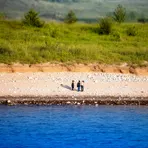
A raised line on the shore that shows how far the water reached in the past
Surface Forms
Morphology
The meaning 'the apparent line on the horizon where the surface of the sea seems to meet the sky' is directly and compositionally derived from 'sea' (a body of water) and 'line' (a dividing or marking line). This follows a transparent noun+noun compound logic that a B1 learner who knows both words can readily infer, even if the exact collocation is not very frequent.
Etymology
Sea line comes from the simple idea of the sea and a line on a map that shows where water meets land. People used a drawn 'line' to mark the 'boundary' between land and sea, so today it means the edge where land and water meet.