

sea lily
- noun
- /siː ˈlɪli/
- Specialized
- Fossils of the sea lily reveal intricate feathery arms once anchored to the ancient seabed.
Examples
-
A sea lily can be found in deep ocean waters.
-
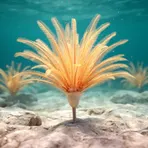
The sea lily waves its arms gently to capture plankton from the surrounding water.
-
Despite its name, the sea lily is an animal, not a plant, related to starfish and sea urchins.
-
Many sea lilies thrive in shallow coral reefs.
-
The sea lily swayed gently in the current, its feathery arms capturing tiny particles of food.
-
While diving, we spotted a vibrant sea lily nestled among the rocks, showcasing its delicate structure.
-
The biologist explained how the sea lily attaches itself to the ocean floor and uses its arms for feeding.
Synonyms
 1
9.9
1
9.9

A sea animal with a central body and feathery arms used to catch food
Surface Forms
Morphology
sea + lily
The compound 'sea' + 'lily' transparently signals a lily-like thing found in the sea, so a B1 learner who knows both words can infer it is a sea organism or object with a flower-like appearance. However, the specific biological nature (that it is a stalked marine animal/crinoid attached to the sea floor rather than a plant) is not predictable from the constituents alone, making some key details unpredictable without prior exposure.
Etymology
Sea lily gets its name from the way it looks: a long stalk with feathery arms that spread like a lily flower on the sea floor. So, even though it looks like a 'plant', the sea lily is actually an 'animal' that stays attached and uses its arms to catch tiny food.