
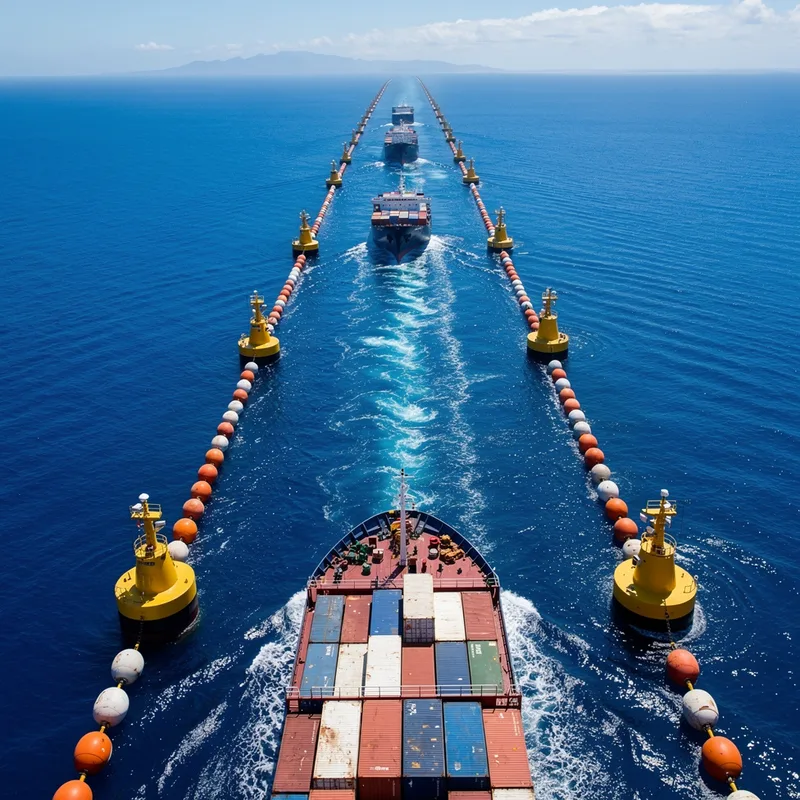
sea lane
 3
4.2
3
4.2

- noun
- /si leɪn/
- Without the Cape sea lane, the Allies would not have held Egypt, the Middle East, or India.
- vital sea lanes
- protect the sea lanes
- secure sea lanes
Examples
-
Singapore's strategic location in the middle of air and sea lanes into Southeast Asia contributed much to this foreign affairs power.
Academic text (1992) -
In ancient times, it was the Mediterranean Sea that provided the sea lanes for world commerce.
Academic text (1990) -
None of the major sea lanes go through it.
-
By doing so, the United States is not "containing" China; it is protecting international sea lanes in the region.
Academic text (1996) -
There are also battles over sea lanes.
Academic text (2008) -
But gradually, countries began to commit more naval power to policing sea lanes.
Academic text (2009) -
We have a common interest in the free flow of commerce, including through the vital sea-lanes of the Indian Ocean.
Academic text (2003) -
Indonesia straddles some of the world's most critical sea lanes, through which substantial levels of regional trade pass.
Academic text (2001) -
Similarly, Washington and Beijing share a common interest in securing open sea lanes to ensure the unhindered passage of cargo ships.
Academic text (2005) -
The Navy is crucial for protecting international sea lanes that facilitate global trade.
Synonyms
 3
4.4
3
4.4
A route through the sea that ships use to travel between places

A path at sea that boats follow regularly

A regular ship route that carries goods or people between ports
How Navigable

Surface Forms
Morphology
sea + lane
The meaning 'a regularly used route at sea' is directly and compositionally derived from 'sea' (body of water) + 'lane' (a designated route or narrow path), following the same logic as land lanes (e.g., bus lane, traffic lane). This is a common, cross-linguistic concept (cf. voie maritime, ruta marítima) so a B1 learner who knows both constituents will readily infer the MWE meaning.
Etymology
Sea lane comes from the image of a road on water: sailors and mapmakers saw that ships kept to the same paths and called them sea lane, like a 'lane' on land. So it means a regular 'route' used by ships.