
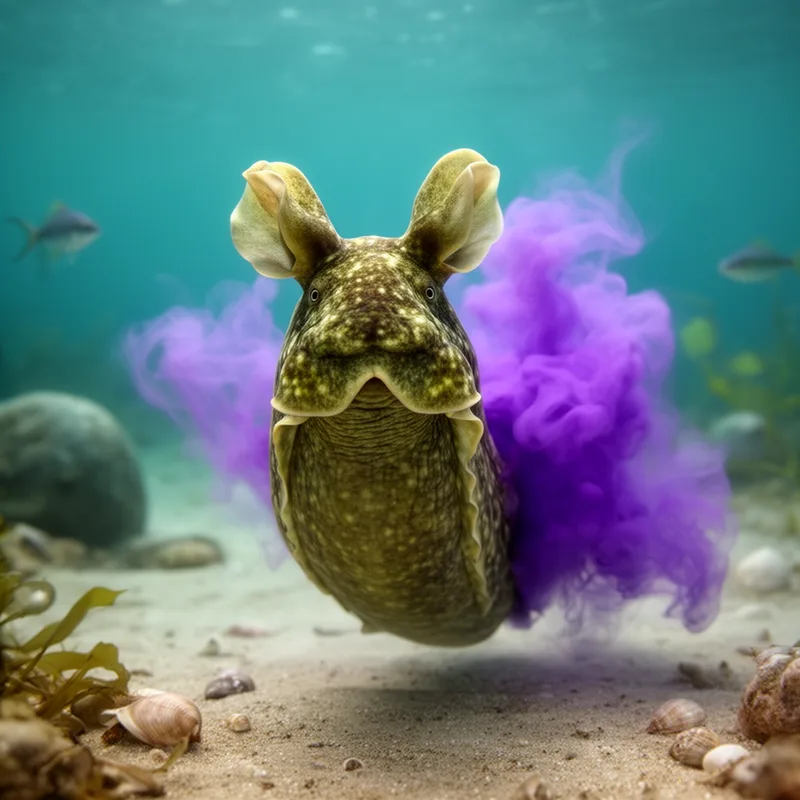
sea hare
- noun
- /siː hɛr/
- Specialized
- Speaking of slimy defenses, sea hares get their name from the long sensory structures on their heads, which somewhat resemble rabbit ears.
Loading YouTube…
Watch on YouTubeSpeaking of slimy defenses, sea hares get their name from the long sensory structures on their heads, which somewhat resemble rabbit ears.
- Speaking of slimy defenses, sea hares get their name from the long sensory structures on their heads, which somewhat resemble rabbit ears.
Examples
-
The sea hare is known for its ability to release a cloud of purple ink when threatened.
-
In the coastal tide pools, there are thousands of these slug things called sea hares.
Fiction book (1991) -
You get a sea hare pissed off; it squirts purple ink at you.
Fiction book (1991) -
It was thicker than the average sea hare and about a yard long.
Fiction book (1991) -
"Not all potential becomes reality," Ricketts wrote, citing the example of the sea hare, which spawns millions of eggs into a hostile ocean so that a handful might survive to adulthood.
Academic text (2007) -
While snorkeling, we saw a large sea hare gliding along the ocean floor, its body soft and colorful.
-
In the rocky crevices of the tide pools, I found a sea hare resting among the seaweed.
Synonyms
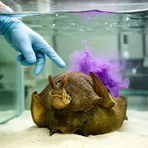
A large sea slug that is called a sea hare
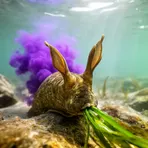
A soft sea slug with two pairs of ear-like tentacles that eats seaweed and can release purple ink
Surface Forms
Morphology
sea + hare
A B1 learner who knows 'sea' and 'hare' can reasonably infer that this is an animal that lives in the sea and has some hare-like feature, because the 'sea + animal' naming pattern (e.g. sea lion, sea horse) is common cross-linguistically. However, the specific sense — that it is a soft-bodied marine mollusc with tentacles — is not predictable from the constituents alone, so the relation is only partially transparent.
Etymology
Sea hare gets its name from a sea slug that has two long, ear-like feelers on its head that look like a rabbit, so people compared it to a hare and the name came to mean this soft sea animal.

