
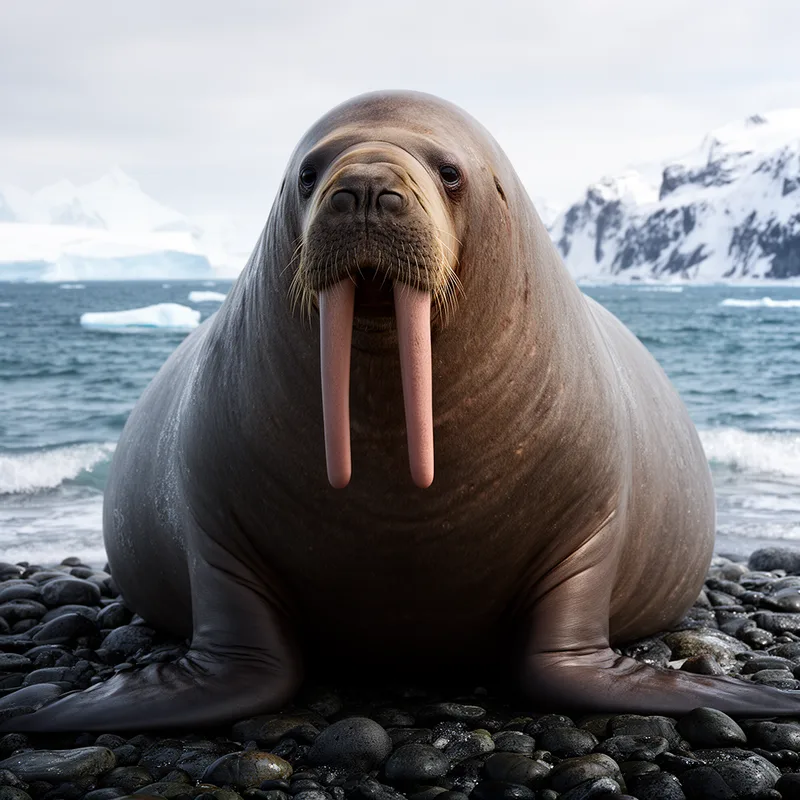
sea elephant
- noun
- /siː ˈɛlɪfənt/
- The massive sea elephant hauled itself onto the shore to rest among the rocks.
Examples
-
Researchers tracked the migration patterns of the sea elephant using satellite tags.
-
A male sea elephant can reach weights of up to 4,000 kilograms during mating season.
-
The sea elephant is known for its large size.
-
Many sea elephants migrate to warmer waters in winter.
-
A male sea elephant can weigh over 4,000 kilograms during mating season, making it one of the largest seal species.
-
Researchers observed a sea elephant resting on the beach after its long migration across the ocean.
-
The sea elephant uses its trunk-like snout to dig in the sand for food when foraging.
Synonyms

 108
1.0
108
1.0

A large sea mammal with flippers that lives near cold coasts
 4
4.2
4
4.2
A very large seal with a nose like an elephant's trunk that lives on beaches

A group of very large sea mammals called elephant seals
Surface Forms
Morphology
sea + elephant
The compound directly combines 'sea' (marine) with 'elephant' (a large land mammal), so the phrase denotes a sea-dwelling animal resembling an elephant; this compositional logic makes the referent predictable. Such naming patterns (e.g., 'elephant seal' / equivalents in other languages) are cross-linguistically common, so a B1 learner who knows the constituent words would readily infer the meaning.
Etymology
Sea elephant comes from sailors who saw very large seals with long, trunk-like noses and heavy bodies and thought they looked like an elephant at sea. That's why the name now means the large seal species also called an 'elephant seal'.