
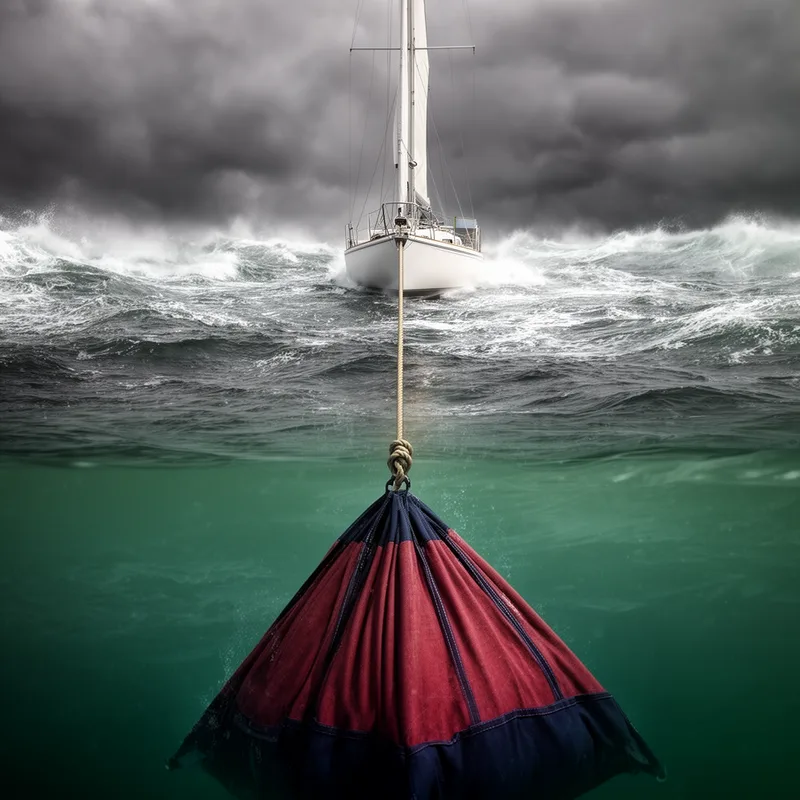
sea anchor
 1
6.5
1
6.5

- noun
- /siː ˈæŋkər/
- Specialized
- A sea anchor is used as a drag to keep the boat's head to the wind.
Examples
-
The raft rides high up on the wave, then shoots down it, but the sea anchor holds, and the raft slows and rides along with the wave.
Fiction book (2000) -
The sailor deployed the sea anchor to stabilize the boat against the strong winds.
-
I have to fix the sea anchor.
Fiction book (2000) -
Let out the sea anchor!
Fiction book (2000) -
Use the sail for a sea anchor and you won't move.
Fiction book (2000) -
If I don't have a sea anchor, I'll capsize.
Fiction book (2000) -
Frantic, Chuck lets out the sea anchor as the raft scuds down a huge wave.
Fiction book (2000) -
That's my sea anchor.
Fiction book (2000) -
Using a sea anchor helps keep the vessel's bow pointed into the wind during a storm.
-
To avoid drifting too far off course, the crew set the sea anchor in the choppy waters.
Synonyms

A canvas device trailed behind a boat to slow its drift and keep its bow facing the wind
Surface Forms
Morphology
The compound 'sea anchor' is directly compositional: combining 'sea' (the ocean) with 'anchor' (a device for holding a vessel) yields an anchor-related device used at sea. While the precise technical function (a towed device to reduce drift) is specialized, a B1 learner who knows both constituents will grasp the general meaning without prior exposure.
Etymology
Sea anchor The noun sea anchor comes from the picture of an anchor used in the sea rather than dropped to the bottom: sailors tow a big cloth or bag behind the boat so it catches the water. That drag 'slows the boat' and 'keeps the front facing the wind and waves', so today a sea anchor means a towed device that reduces drift.