
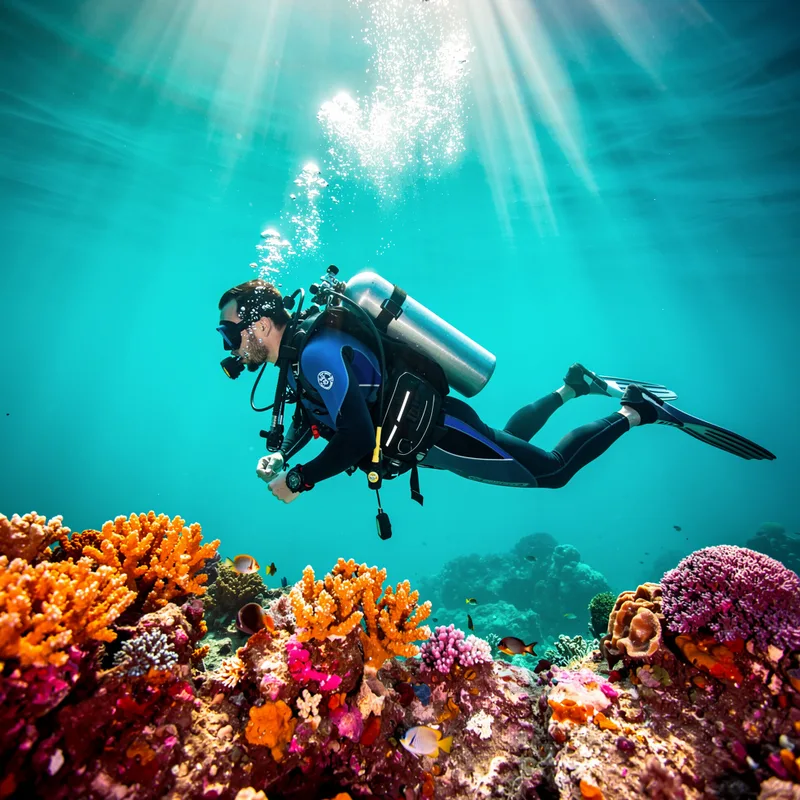
scuba diving
 18
3.2
18
3.2

- noun
- /ˈskuːbə ˈdaɪvɪŋ/
- "What I'd really like to try is scuba diving," said Tony easily, picking his way through the Latham minefield.
- scuba diving club
Loading YouTube…
Watch on YouTubeSo what what came first, scuba diving or aquatic animal minds?
- So what what came first, scuba diving or aquatic animal minds?
- If it's like contractual, like if you're a boat captain, I bet the scuba diving there is really fun.
- You don't have a lot of natural resources, but it's a beautiful country with pristine waters and scuba diving and fascinating history.
- And by fix I mean get rid of it and how to make sure you never die when you're in a scuba diving situation.
- So I I certified scuba and after three years of exploring that like free diving, we finally came up with a full scuba diving expedition.
- I did every scuba diving course, you know, I could at the earliest age possible.
- So it's kind of like paragliding and skydiving mixed in with scuba diving and sailing or power speedboat or whatnot.
- Yeah, it's underwater, scuba diving, whale sharks, it's everywhere.
Examples
-
He is a teacher of scuba diving and is involved with several charities.
-
Oh, I booked you in for scuba diving tomorrow.
-
How old does a child have to be to do scuba diving?
-
Have you heard of scuba diving?
-
Shame it's too late to go scuba diving.
-
When he was stationed in Japan, he went scuba diving every weekend.
Blog text (25) -
Imagine yourself scuba diving off the California coast, out by the continental shelf.
Fiction book (1991) -
I still haven't tried scuba diving, but once I save up enough money.
Blog text (13) -
I was terrified to try ziplining and scuba diving, but I signed up for both anyway.
Blog text (13) -
Next summer, we plan to go scuba diving at a beautiful coral reef.
How Difficult
18
3.2

- US
16
3.0
Surface Forms
Morphology
The meaning is directly compositional: 'scuba' denotes the breathing equipment and 'diving' denotes the activity of going underwater, so a learner who knows both constituents can infer it refers to diving using scuba gear. This is a common, cross-linguistically transparent formation and follows regular noun-noun compounding patterns, making it immediately understandable to B1 learners.
Etymology
The noun scuba diving comes from scuba, which was made from the first letters of the phrase 'self-contained underwater breathing gear', and diving, meaning going under the water. So scuba diving means 'diving while you carry your own air tank to breathe underwater'.