

sclerotic
- adjective
- /skləˈrɒtɪk/
- Specialized
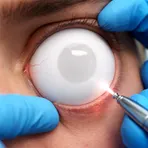
- The sclerotic tissue around the eye helps maintain its shape and integrity.
Examples
-
Sclerotic changes in the eye can indicate underlying health issues.
-
That's known as sclerotic damage.
-
In a few patients, sclerotic patches were found consistent with the mature phase of otosclerosis.
Academic text (1995) -
In a review of 39 biopsy-proven cases, Fries found that 56% were pagetoid, 23% were sclerotic, and 21% were cystic.
Academic text (2008) -
Her eye doctor explained that the sclerotic layer of the eyeball protects its inner structures.
Synonyms


 1
9.2
1
9.2
Relates to the white outer part of the eye
Compounds


Surface Forms
Morphology
sclerotic = sclera (semi-transparent) = scler + otic
Formally related to 'sclera' but the medical adjective-forming suffix '-otic' and overlap with the 'hardened' sense make the relation less obvious to non-specialist learners.
Etymology
Sclerotic comes from the Greek root skleros, meaning 'hard'. It is the same root in sclera, the tough white layer of the eye, so sclerotic in this sense means 'relating to that hard outer layer'.