
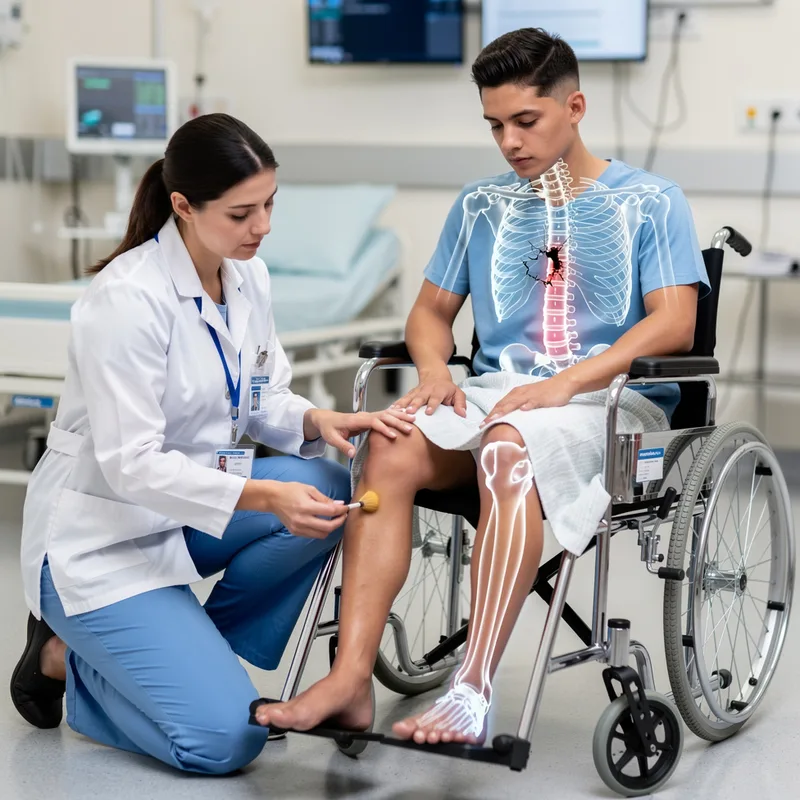
sci
 3
9.9
3
9.9

- noun
- Specialized
- Many people learn to adapt their lifestyle after a spinal cord injury (SCI).
- SCI quadriplegics
- SCI individuals
- SCI subjects
Loading YouTube…
Watch on YouTubeSo if you have SCI and access to special handling, that's what special handling means.
- So if you have SCI and access to special handling, that's what special handling means.
Examples
-
Based on our earlier work, even those with long-term SCI would be expected to demonstrate some bone loss.
Academic text (1991) -
Participants with chronic tetraplegia owing to cervical spinal cord injury (SCI) were recruited from the research volunteer database of The Miami.
Academic text (2015) -
As defined by most people, those with SCI are likely never to return to normal.
Blog text (30) -
For those with SCI, there is a struggle to get back to a normal life.
Blog text (30) -
In the neutral posture, on average, the maximum pressure for a person with SCI is 26 percent higher.
Academic text (1992) -
Ten non-disabled and 12 SCI subjects participated in the study.
Academic text (1992) -
However, SCI individuals with severe osteoporosis may require a lower maximum load resistance to prevent injury.
Academic text (1991) -
The varied degree to which those with SCI are afflicted requires that the definition be quite flexible.
Blog text (30) -
In addition, FNS-KE exercise appeared to decrease the rate of tibial bone loss in our SCI subjects.
Academic text (1991) -
Safety is always a concern with involuntary electrically induced exercise in the SCI population.
Academic text (1991)
Surface Forms
Etymology
Sci stands for spinal cord injury, made from the words 'spine' and 'injury', so it refers to damage to the spine that can stop movement or feeling.