
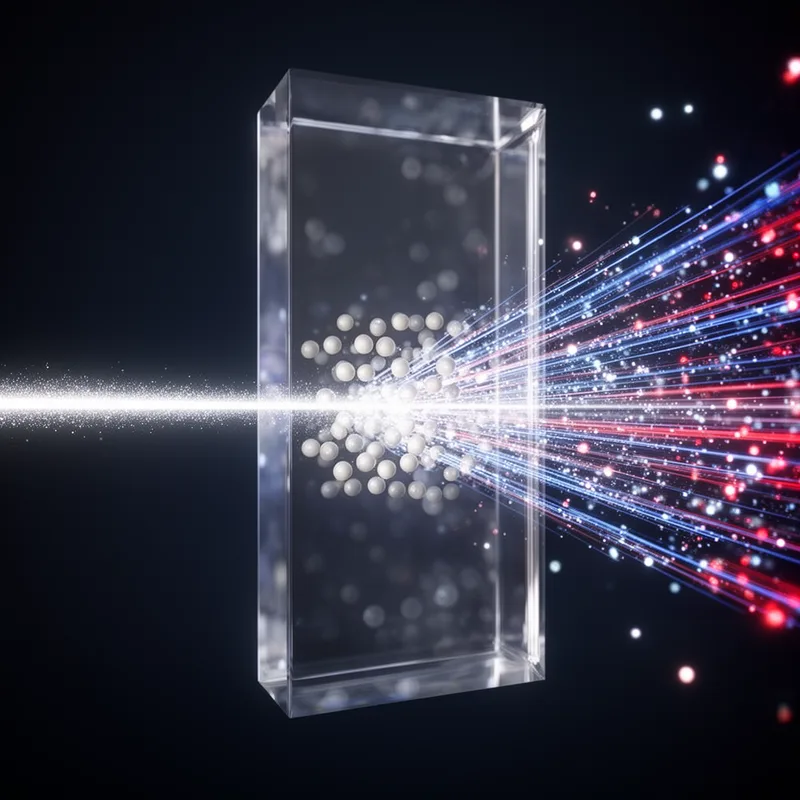
scattering
 2
6.7
2
6.7

- noun
- /ˈskætərɪŋ/
- Specialized
- The scientist studied the scattering of particles to understand how light interacts with different materials.
- light scattering
- inelastic scattering
- neutron scattering
Loading YouTube…
Watch on YouTubeAs we increase the greenhouse gases in the Earth's atmosphere, people have speculated that the scattering will change.
- As we increase the greenhouse gases in the Earth's atmosphere, people have speculated that the scattering will change.
- They once they reform or once they form with the protons in that scattering process can no longer happen.
Examples
-
Snow looks white because it's scattering light elastically.
-
The sky goes dark because of the absorption and scattering of the infrared band in the atmosphere.
Academic text (1993) -
Compton further observed that the larger the scattering angle, the larger the indicated loss of energy.
Academic text (1990) -
As we increase the greenhouse gases in the Earth's atmosphere, people have speculated that the scattering will change.
-
Now you have a Mars sized impactor that sideswipes the Earth, scattering Earth's crust into a ring around the Earth.
-
In areas of sediment runoff, large particles dominate the scattering, decreasing the wavelength dependence of the backscattering.
Academic text (2011) -
In the atmosphere, the scattering of sunlight by particles causes the beautiful colors of sunrise and sunset.
-
During the experiment, they observed the scattering of sound waves as they passed through different mediums.
Synonyms
 5
6.5
5
6.5
The spreading of people or things across a wide area
 2
7.0
2
7.0
Spreading out of something until it becomes less concentrated
How Much
5
6.5

- Specialized
2
6.7

 1
2.3
1
2.3
- Specialized
4
7.9
10
2.1
Surface Forms
Morphology
Etymology
Scattering comes from the verb scatter, meaning 'to send things in different directions'; in science it describes small bits or waves hitting something and flying off in many ways. So the scientific use of scattering means particles or light are sent out in different directions, which is why the sky can look blue or red.