
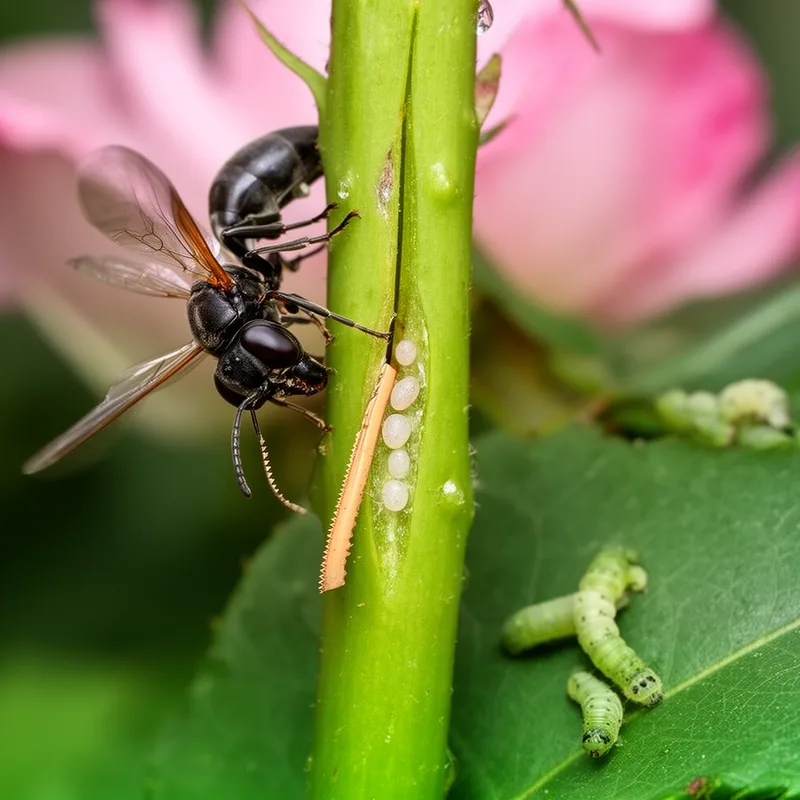
sawfly


 1
9.3
- noun
- /ˈsɔːflaɪ/
- Larvae of some sawfly species form aggregations, but not eusocial colonies, and the adults lead solitary lives (Costa 2006).
- sawfly species
Examples
-
Biological control researchers agree that the insect most likely to follow the melaleuca leaf weevil may be the sawfly Lophyrotoma zonalis.
Academic text (1997) -
In spring, the tiny black sawfly lays eggs in half-grown birch leaves.
-
These rigorous tests garnered the first-ever federal and state approvals to ship the sawfly and psyllid to Florida.
Academic text (1997) -
PHOTO (COLOR): A melaleuca sawfly adult prepares to deposit eggs on a melaleuca leaf.
Academic text (1997) -
Each inch-and-a-quarter-long sawfly larva "has a tiny horn on its back, making it look something like a little hornworm caterpillar," says Buckingham.
Academic text (1997) -
For example, Haack and Mattson (1993) discovered that alien, tree-feeding sawflies in North America are more prone to cause outbreaks than the equivalent native species.
Academic text (1996) -
The most promising candidates include four additional species native to Australia: a beneficial sawfly, a sap-feeding psyllid (SILL-id), a tube-dwelling moth, and a gall-forming fly.
Academic text (1997) -
The wheat stem sawfly is a major problem in the Mediterranean Basin.
-
By early June, small black sawflies are marauding over the fresh leaves of our gray birches, laying eggs inside.
Surface Forms
Morphology
Etymology
Sawfly comes from saw meaning 'to cut' and fly because the female has a 'saw'-like egg-laying part she uses to cut into plants to lay eggs. So the name points to the insect and its way of laying eggs.