

saw palmetto
 1
7.2
1
7.2

- noun
- /sɔː pælˈmɛtoʊ/
- US
- In traditional medicine, saw palmetto was used to treat various urinary issues.
- saw palmetto extract
- saw palmetto supplement
- saw palmetto, an herb
Loading YouTube…
Watch on YouTubeThe most common are saw Palmetto, nettle roots and pumpkin seed extract.
- The most common are saw Palmetto, nettle roots and pumpkin seed extract.
Examples
-
This nutrient-poor soil supports longleaf pine, turkey oak, saw palmetto, bracken fern, and little else.
Academic text (1993) -
This plant is called saw palmetto.
Blog text (20) -
Saw palmetto is a very common and effective treatment for preventing thinning hair.
Blog text (28) -
Eventually, the saw palmettos regain their prominence in the understory.
Academic text (1991) -
In the longleaf pine forests, fire knocks back the dense growth of saw palmettos.
Academic text (1991) -
The region is primarily flat, with stretches of longleaf pine growing in dry sand above an understory of saw palmetto.
Academic text (1993) -
Festooned with Spanish moss, a live oak grows in a mesic hammock along with saw palmetto.
Academic text (2010) -
At the higher and drier end of the spectrum is a forest dominated by longleaf pines, with a dense, often impenetrable undergrowth of saw palmettos.
Academic text (1991) -
Newsom has found that the Calusa used a number of wild plants like prickly pear, cabbage palm, saw palmetto, hog plum, and acorns.
Academic text (2004) -
Many men use saw palmetto to relieve symptoms of an enlarged prostate.
Synonyms
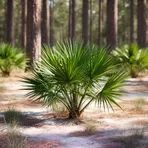
A small spiny palm that grows wild in the southern United States
Surface Forms
Morphology
The term is a descriptive noun–noun compound: 'saw' modifies 'palmetto' to indicate a palmetto with saw-like or spiny leaves, so a learner who knows 'saw' and 'palmetto' can infer it is a type of palm with serrated/spiny leaves. This compositional, descriptive pattern for plant names is common cross-linguistically, making the meaning directly derivable from the parts.
Etymology
Saw palmetto is named for the plant's sharp, saw-like leaf edges, which give the saw part of the name, and palmetto means 'small palm'. That's why the name describes a small palm with spiny leaves.