
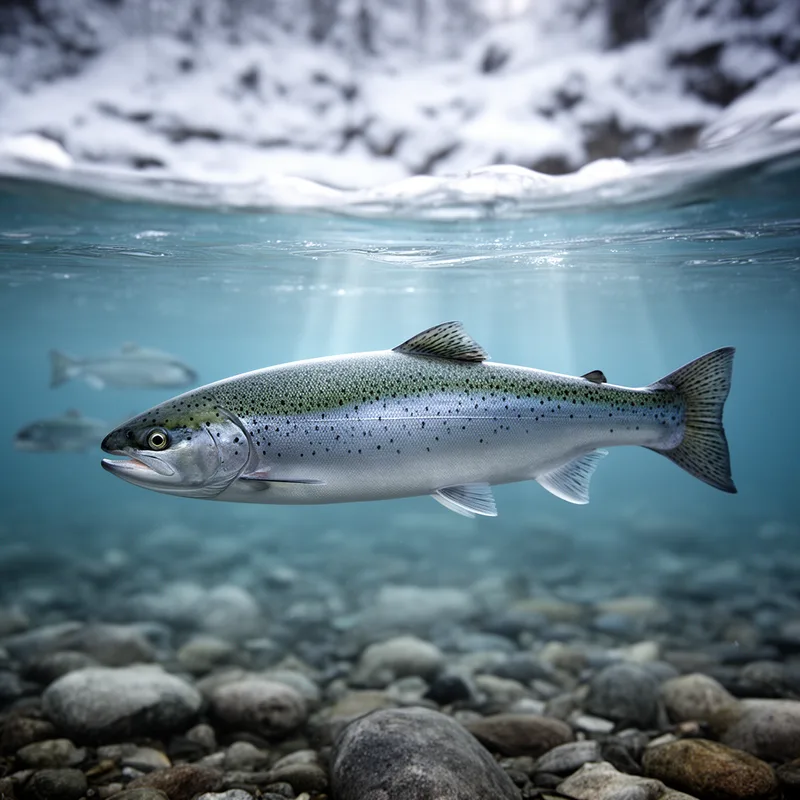
salmonid


 1
8.7
- noun
- /ˈsælmənɪd/
- Specialized
- The salmonid species migrate to freshwater rivers to spawn each year.
- anadromous salmonids
- Pacific salmonids
- salmonid fish
Examples
-
Salmonids require spawning habitats that have cool, clear water and stable gravel beds.
Academic text (2017) -
The unstable channels also typically provide poor habitat for spawning and rearing salmonid fish.
Academic text (2007) -
The ability to move is crucial to every part of the salmonid cycle.
Academic text (2017) -
The problem is complicated by the fact that different salmonid species have different movement patterns and habitat requirements.
Academic text (2017) -
As the case studies demonstrate, past decisions on salmonid habitat conservation have not been based on science alone.
Academic text (2018) -
In Atlantic Canada, the Salmonid Demonstration and Development Farm was established to help local salmon farmers.
Academic text (1990) -
The first is a survey of salmonid populations in Oregon's coastal streams.
Academic text (2001) -
Juvenile salmonids require a diverse and connected habitat that utilizes practically every segment of the stream environment.
Academic text (2017) -
The geographic focus on high-latitude and high-altitude rivers entails that salmonids, the predominant fish family in this region, are over-represented in the literature.
Academic text (2013) -
The agency developed separate conservation strategies for spotted owls, marbled murrelets, salmonids, and a "multi-species" strategy that provided habitats for forty-nine other at-risk wildlife species.
Academic text (2018)
Surface Forms
Morphology
Etymology
Salmonid comes from the fish name salmon and the scientific ending -id or -idae, which means 'belonging to a family'. So a salmonid is a fish that belongs to the salmon family, like salmon and trout.