
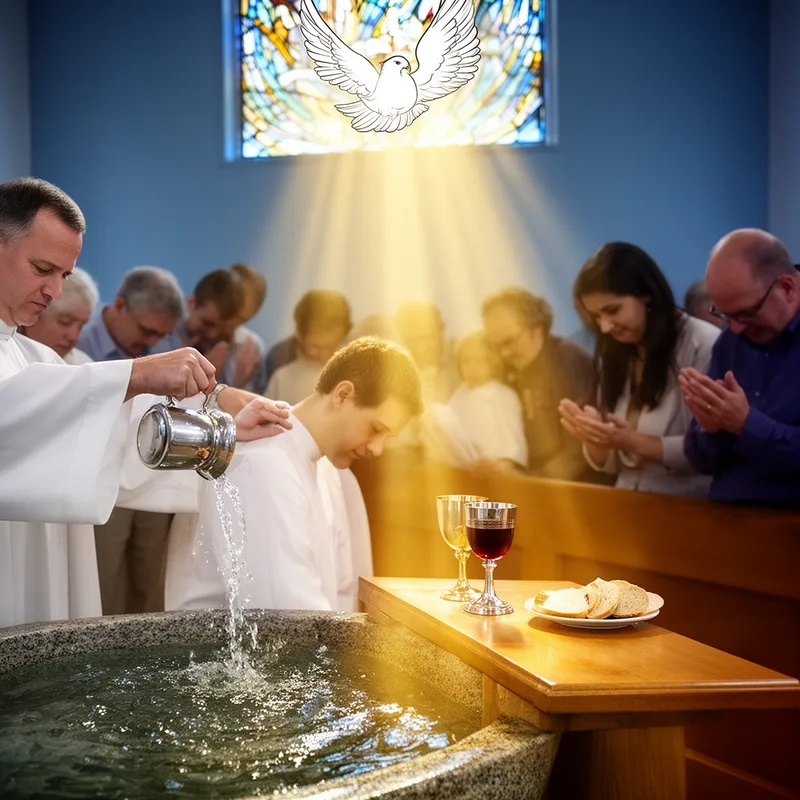
sacramentalism
- noun
- /ˌsækrəˈmɛntəlɪzəm/
- Many Christians believe that sacramentalism plays a crucial role in their spiritual journey to receive divine grace.
Examples
-
Still, the sacramentalism (that is, the use of the sign as a vehicle to reach the divine presence) implicit in Bushnell's perception of language and image hints at another way to make sense of the paradox.
Academic text (2010) -
They subsist on the personality-ridden, cultic sacramentalism of the music.
Academic text (2000) -
The first demand was opposed by the church's universalism of grace; the second by the priesthood's sacramentalism.
Academic text (1991) -
I look forward to meeting John Calvin and asking him why he retained such a strong element of sacramentalism in his understanding of the Lord's Supper, and whether he was really convinced by his arguments in favor of infant baptism!
Blog text (9) -
David R: To me, the distinction between the sacramentalism of Rome and the covenantalism of Geneva seems obvious, but if you want to see Calvin as striking a via media between Rome and Munster, I won't argue.
Blog text (26) -
In Same-Sex Desire in Victorian Religious Culture, Frederick S. Roden explains how such embodiment was an essential component of Catholicism for the Fields, particularly Edith Cooper: "The carnality of Catholic sacramentalism drew her to the Church."
Academic text (2016) -
The church emphasizes sacramentalism as a necessary doctrine for understanding the importance of rituals in achieving salvation.
-
Her study on sacramentalism highlighted how religious ceremonies can be seen as direct means to connect with the divine.
How Sacramental

- Specialized


 1
9.9
1
9.9
Surface Forms
Morphology
sacramentalism = sacramental (transparent) = sacrament + al + ism
Formed by the adjective 'sacramental' + '-ism' denoting a doctrine or belief about sacraments, a straightforward derivation.
Etymology
Sacramentalism comes from sacrament, which comes from Latin sacer meaning 'holy' or 'sacred', and the ending -ism meaning 'belief'. A sacrament is a 'holy act' like baptism or communion, so sacramentalism is the belief that these acts are real ways God gives help and are necessary to be saved.