
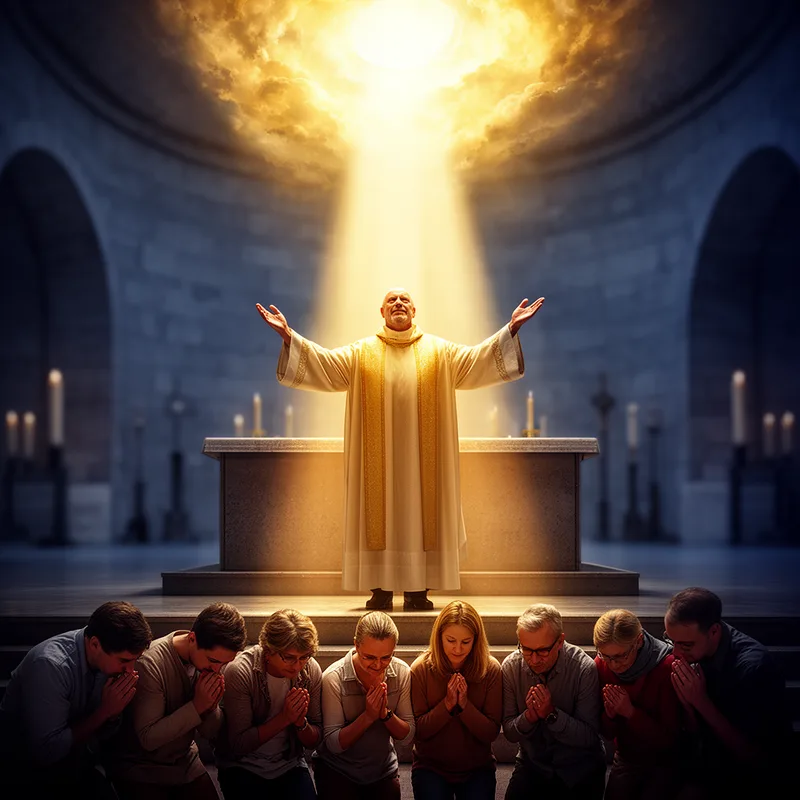
sacerdotalism
- noun
- /ˌsæsərˈdoʊtəlɪzəm/
- Formal
- Some Christian denominations reject sacerdotalism in favor of direct access to God.
Examples
-
The doctrine of sacerdotalism played a major role in medieval church structure.
-
The church's sacerdotalism emphasizes the importance of priestly mediation.
-
Debates about sacerdotalism have shaped many theological discussions in history.
-
Many followers embrace sacerdotalism as a core belief.
-
Many followers embrace sacerdotalism as a core belief that shapes their faith practices.
-
Some Christian denominations reject sacerdotalism and promote the idea of direct communion with God.
-
The doctrine of sacerdotalism has historically influenced the structure and function of the church.
How Priestly


Surface Forms
Morphology
sacerdotalism = sacerdotal (opaque) = sacerdot + al + ism
Forming a doctrine/ideology from the adjective 'sacerdotal' with the productive suffix '-ism' is a standard, regular derivation.
Etymology
The word sacerdotalism comes from the Latin root sacerdot- 'priest' and the ending -ism 'belief', and it is related to sacred 'holy'. So, sacerdotalism is the belief that priests act as a bridge between people and God.