
rutile


 1
9.9
- noun
- /ˈruːtaɪl/
- Specialized
- Natural rutiles contain iron, vanadium, niobium, and tantalum, whose concentrations, along with those of other minor constituents, serve to identify the mine that produced the rutile.
Examples
-
SIMS analyses in one FSC investigation of counterfeit notes measured anomalously large rutile particles that were extremely enriched in tungsten.
Academic text (1998) -
The synthetic rutile used in US currency, by contrast, is chemically very pure, and its size distribution sharply peaks below 1 µm.
Academic text (1998) -
So, what is this Rutile stuff anyway?
-
You've got a valuable mineral on your property called Rutile.
-
Rutile is used as a filler and coloring agent in currency paper.
Academic text (1998) -
On the bottom of the jug, an inscription bears the name Rutile Hipucartes, the Etruscanized form of the Greek name Hippocrates.
Academic text (2010) -
Natural rutiles contain iron, vanadium, niobium, and tantalum, whose concentrations, along with those of other minor constituents, serve to identify the mine that produced the rutile.
Academic text (1998) -
Will display various single crystalline materials and substrates, such as sapphire, strontium-titanate, rutiles, metal single crystals, InP, etc. Also on display will be its Precision Wire Saw for cutting soft to hard materials.
Academic text (1997) -
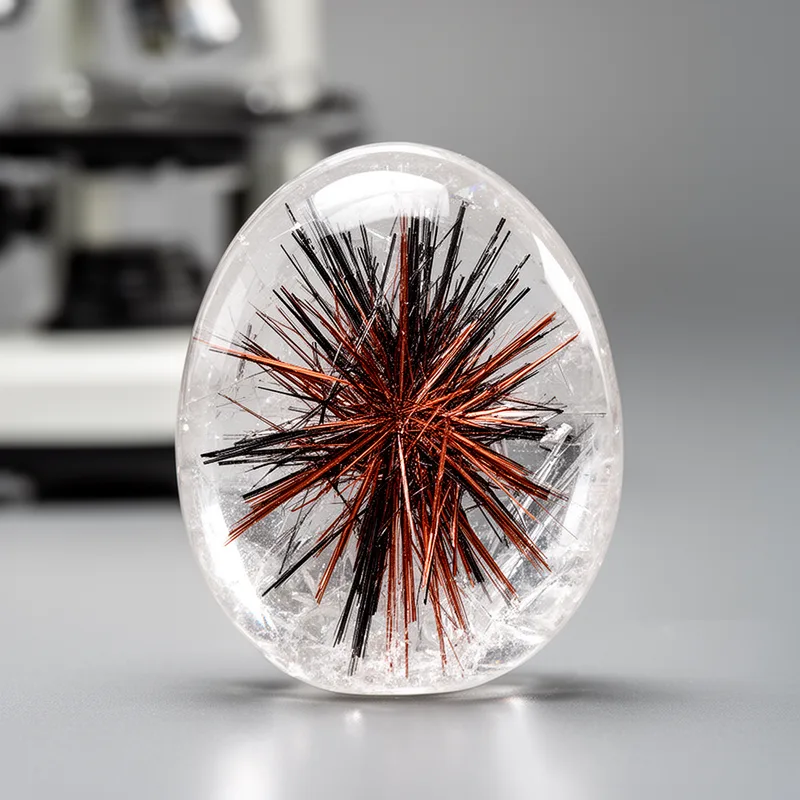
The geologist identified the rutile crystals in the rock sample due to their characteristic reddish-brown color.
-
Rutile is often used as a key ingredient for producing rutile in various industrial applications.
Surface Forms
Etymology
The word rutile comes from the Latin rutilus, which means 'red' or 'reddish', because many rutile crystals are reddish-brown. That's why rutile refers to this reddish mineral made of thin, needlelike crystals and is a main source of titanium.