
runout


 1
8.4
- noun
- /ˈrʌnˌaʊt/
- Radial runout software on LMI Selcom's SLS 6000 laser sensor is designed to clean up information on tire roundness, the company says.
- radial runout
Examples
-
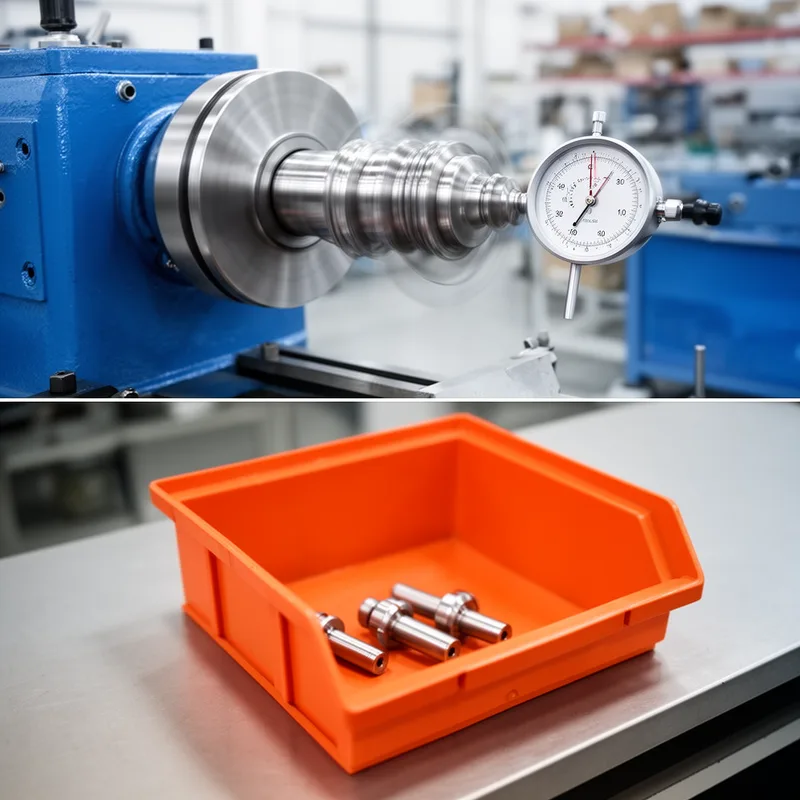
During the inspection, the technician noted the runout of the shaft exceeded acceptable limits.
-
Runout typically is present across the whole width of the tire surface, said Snow.
Academic text (2001) -
The result is a filtered representation of the tire's runout.
Academic text (2001) -
Tires are placed on moment machines, which spin them to check for eccentricity, also known as radial runout.
Academic text (2001) -
The radial runout software has been incorporated on three of the company's SLS series laser sensors.
Academic text (2001) -
If the concrete mixer is a self-falling one, its discharging retaining ring has a runout of less than 1% of the feeding inlet diameter.
Blog text (26) -
The VSA(R)-3D tolerance tool was used successfully on the spindle/motor in predicting runout, disk-stack envelopes, and imbalance numbers.
Academic text (1996) -
The radial runout software can be installed on three SLS series sensors: the SLS5000, designed for regular duty tire inspection; the SLS6000, for industrial and agricultural tires; and the LSH2401, for measuring in tight spaces.
Academic text (2001) -
The mechanic measured the runout of the wheel to ensure it was not affecting the car's performance.
-
When the tire's runout is too high, it can lead to uneven wear and a rough ride.
Antonyms


Surface Forms
Morphology
Etymology
Runout comes from run ('to move') and out ('away' or 'finished'). Think of something 'running' away from its correct place — in machines this is when a rotating part or wheel moves off centre and wobbles instead of turning correctly, and in everyday use it means supplies have 'run out' or are used up.